
6.4

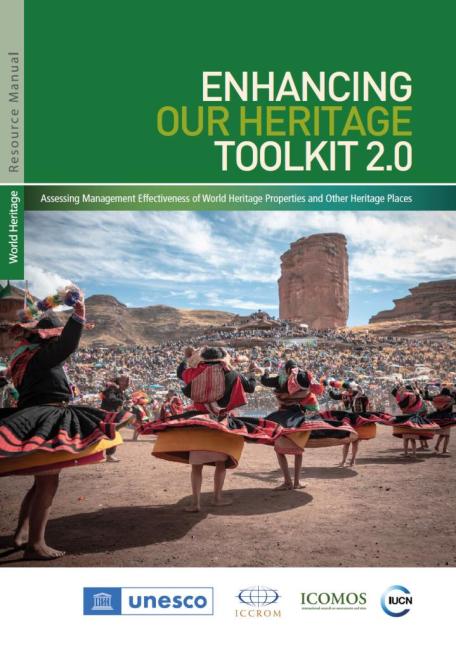
Enhancing Our Heritage Toolkit 2.0 - Assessing management effectiveness of World Heritage properties and other heritage places

The manual Enhancing Our Heritage Toolkit 2.0 (EoH 2.0) offers a detailed management effectiveness methodology that is suited to the specific needs of World Heritage properties but can be applied to all other natural and cultural heritage places. It contains twelve tools that can be used separately or collectively to evaluate the effectiveness of a management system. Each tool has a specific purpose and includes guidance to help managers engage in full and open discussion about the most critical elements of the management system. To facilitate their use, the tools are accompanied by worksheets and prompt questions to help compile information in a systematic way and to help managers identify opportunities for improvement and necessary actions. Together, the tools offer an iterative methodology that will enable managers to identify what is working well and what can be done better.

EoH 2.0 has three important qualities:

  1. It is the only management effectiveness methodology specifically tailored to all types of heritage places.
    It has been developed to suit cultural and natural heritage places and, while there is a focus on World Heritage properties, it can be applied to all heritage places, regardless of designation(s) at international, national and/or local levels.
  2. It is a fully self-assessed methodology. EoH 2.0 is designed to be used directly by managers – generally without external support, validation or information sharing, unlike some of the other methodologies, which are externally led (such as the IUCN The International Union for Conservation of Nature (IUCN) is an international membership association composed of both government and civil society organizations. It harnesses the experience, resources and reach of its member organizations and the input of its experts to promote nature conservation and accelerate the transition to sustainable development. The headquarters of the IUCN Secretariat are located in Gland, Switzerland.Created in 1948, IUCN has evolved into the world’s largest environmental network: IUCN experts are organized into six commissions dedicated to species survival, environmental law, protected areas, social and economic policy, ecosystem management and education and communication. World Heritage Outlook) or need a level of external validation (such as the IUCN The International Union for Conservation of Nature (IUCN) is an international membership association composed of both government and civil society organizations. It harnesses the experience, resources and reach of its member organizations and the input of its experts to promote nature conservation and accelerate the transition to sustainable development. The headquarters of the IUCN Secretariat are located in Gland, Switzerland.Created in 1948, IUCN has evolved into the world’s largest environmental network: IUCN experts are organized into six commissions dedicated to species survival, environmental law, protected areas, social and economic policy, ecosystem management and education and communication. Green List), or share information with external actors (such as
    the Periodic Reporting A statutory requirement of the World Heritage Convention The Convention Concerning the Protection of the World Cultural and Natural Heritage is an international treaty adopted by the UN in 1972 that defines the kind of natural or cultural sites which can be considered for inscription on the World Heritage List for their Outstanding Universal Value for all humankind. Commonly known as the World Heritage Convention, it establishes how the international community as a whole is responsible for
    the protection of such heritage and sets out the duties of States Parties in identifying potential sites that may be eligible for inscription onto the World Heritage List and their role in protecting and preserving them. By signing the Convention, each country pledges to conserve not only the sites situated on its territory that have been recognized as being of Outstanding Universal Value, but also to protect its national heritage and to be involved in international efforts to protect, conserve and promote the heritage of humankind.
    that requests States Parties The countries that have ratified the World Heritage Convention The Convention Concerning the Protection of the World Cultural and Natural Heritage is an international treaty adopted by the UN in 1972 that defines the kind of natural or cultural sites which can be considered for inscription on the World Heritage List for their Outstanding Universal Value for all humankind. Commonly known as the World Heritage Convention, it establishes how the international community as a whole is responsible for
    the protection of such heritage and sets out the duties of States Parties in identifying potential sites that may be eligible for inscription onto the World Heritage List and their role in protecting and preserving them. By signing the Convention, each country pledges to conserve not only the sites situated on its territory that have been recognized as being of Outstanding Universal Value, but also to protect its national heritage and to be involved in international efforts to protect, conserve and promote the heritage of humankind.
    . By ratifying the Convention, States Parties commit themselves to undertake actions directed to:
    identifying, knowing, protecting and promoting the cultural and natural heritage located on their territories;adopting a general policy aiming to give their cultural and natural heritage a function in the life of the community;integrating the protection of that heritage into comprehensive planning programmes;setting up services for the protection, conservation and presentation of the cultural and natural heritage with an appropriate staff and possessing the means to carry out their functions;developing scientific and technical studies and research to counteract the dangers that threaten their cultural or natural heritage;taking the appropriate legal, scientific, technical, administrative and financial measures necessary for the identification, protection, conservation, presentation and rehabilitation of their heritage;
    • fostering the establishment or development of national or regional centres for
    training in the protection, conservation and presentation of their cultural and
    natural heritage;encouraging scientific research in this field.As members of the international community and while respecting the sovereignty of each State, States Parties to the Convention also recognize their duty to collectively contribute to the protection of the properties inscribed on the World Heritage List. Therefore, upon request by other States Parties to the World Heritage Convention The Convention Concerning the Protection of the World Cultural and Natural Heritage is an international treaty adopted by the UN in 1972 that defines the kind of natural or cultural sites which can be considered for inscription on the World Heritage List for their Outstanding Universal Value for all humankind. Commonly known as the World Heritage Convention, it establishes how the international community as a whole is responsible for
    the protection of such heritage and sets out the duties of States Parties in identifying potential sites that may be eligible for inscription onto the World Heritage List and their role in protecting and preserving them. By signing the Convention, each country pledges to conserve not only the sites situated on its territory that have been recognized as being of Outstanding Universal Value, but also to protect its national heritage and to be involved in international efforts to protect, conserve and promote the heritage of humankind.
    , they may provide their help in the identification, protection, conservation and presentation of the cultural and natural heritage located on the territory of those countries. Each State Party to the World Heritage Convention The Convention Concerning the Protection of the World Cultural and Natural Heritage is an international treaty adopted by the UN in 1972 that defines the kind of natural or cultural sites which can be considered for inscription on the World Heritage List for their Outstanding Universal Value for all humankind. Commonly known as the World Heritage Convention, it establishes how the international community as a whole is responsible for
    the protection of such heritage and sets out the duties of States Parties in identifying potential sites that may be eligible for inscription onto the World Heritage List and their role in protecting and preserving them. By signing the Convention, each country pledges to conserve not only the sites situated on its territory that have been recognized as being of Outstanding Universal Value, but also to protect its national heritage and to be involved in international efforts to protect, conserve and promote the heritage of humankind.
    undertakes not to take any deliberate measures that might damage, directly or indirectly, the cultural and natural heritage situated on the territory of other States Parties to the Convention.
    States Parties identify and nominate sites on their national territory to be considered for inscription on the World Heritage List. Once inscribed, States Parties assume the primary responsibility for the protection of those properties and to do all they can to achieve this purpose. They are also requested to report periodically on the state of conservation of those properties as well as on the provisions they have adopted to implement the Convention.
    to submit a report usually every six years on the legislative and administrative provisions they have adopted and other actions that they have taken for the application of the Convention, including the state of conservation of the World Heritage properties located on their territories.
    exercise).
  3. It is the most detailed and comprehensive management assessment methodology. EoH 2.0 contains a set of twelve practical tools tailored to make in-depth assessments of critical elements of the
    management system for a World Heritage property A cultural, natural or mixed heritage place inscribed on the World Heritage List and therefore considered to be of OUV for humanity. The responsibility for nominating a property to the World Heritage List falls upon the State(s) Party(ies) where it is located. The World Heritage Committee decides whether a property should be inscribed on the World Heritage List, taking into account the technical recommendations of the Advisory Bodies following rigorous evaluation processes.
    When used as a general term, World Heritage refers to all the natural, cultural and mixed properties inscribed on the World Heritage List.
    or other heritage place. It uses a participatory process to better understand the underlying reasons why certain elements of the management system
    may not be working as effectively as they could be.
    Assessment findings should lead to improvements in the management system. The long-term goal is to repeat the assessment at regular intervals to allow managers to track progress over time. A one-off assessment, while beneficial, is only a diagnosis at a given moment. Assessments are only worth the time and energy needed to undertake them if they lead to improvements in management measures to identify gaps and challenges.
     

The results of the follow-up actions and recommendations defined to address the gaps and challenges throughout the assessment can only be measured after implementation, which requires time. This is why management effectiveness assessments should be embedded in the management cycle and linked with scheduled timings for revisions of the management plan. If there is a great array of gaps and challenges, it will not be possible to address them all in a single management cycle, and longer periods of time will be required. This reinforces the need to repeat the assessments at regular intervals in order to evaluate how management effectiveness is progressing.

Therefore, all assessments must conclude with the development of an action plan or strategy to prioritize and implement findings and follow-up actions. Some of these actions can be included in the next management plan; others may require dedicated efforts, for example, if related to changes in the boundaries or in the legal framework.
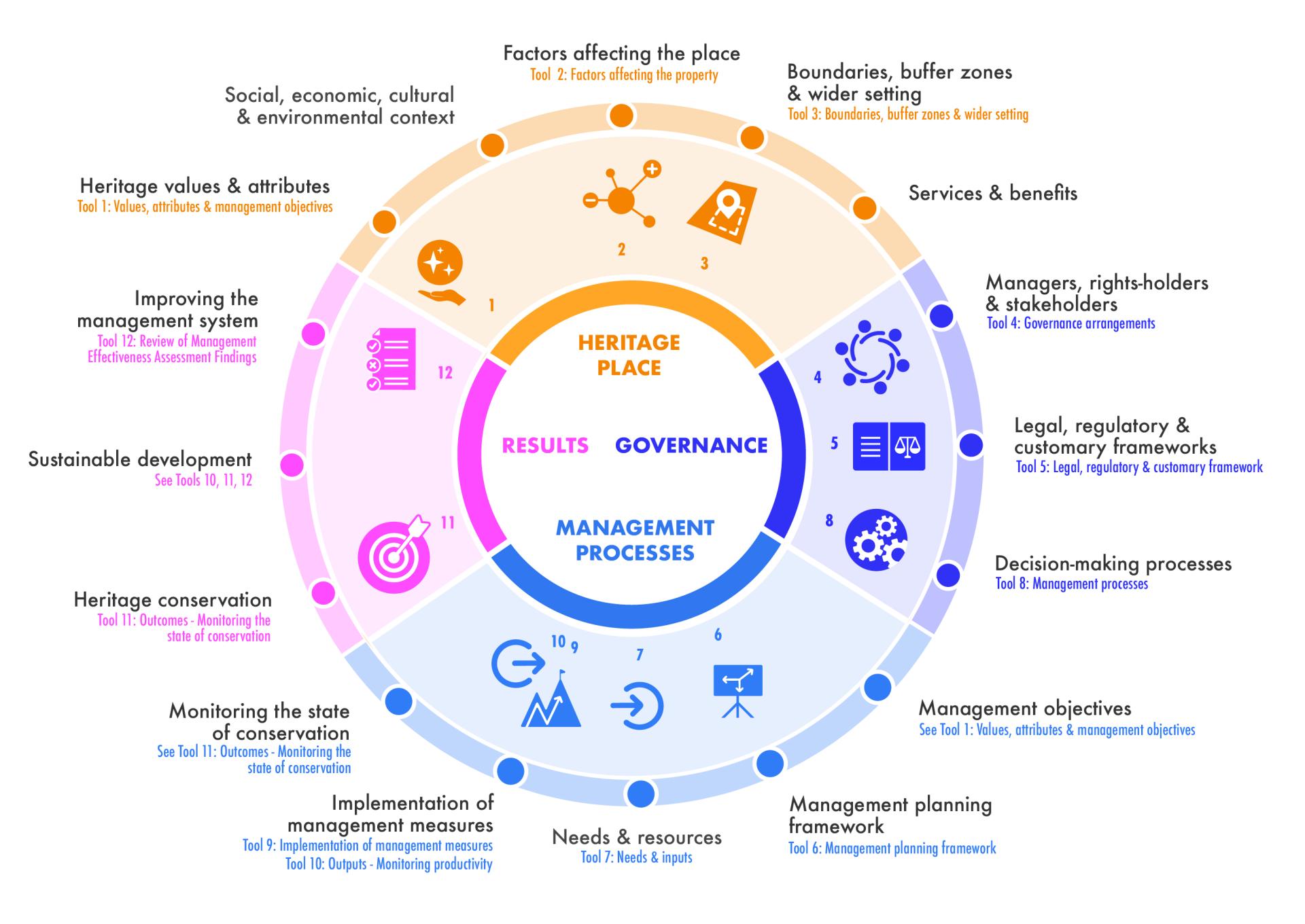
Figure 6.1 The twelve tools from the manual Enhancing our Heritage All inherited assets that people value for reasons beyond mere utility. Heritage is a broad concept and includes shared legacies from the natural environment, the creations of humans and the creations and interactions of humans and nature. It encompasses built, terrestrial, freshwater and marine environments, landscapes and seascapes, biodiversity, geodiversity, collections, cultural practices, knowledge, living experiences, etc. Toolkit 2.0 can be used separately orcollectively to evaluate the effectiveness of the management system. The tools can be used to analyse the most critical elements of the management system. The social, economic, cultural and environmental context together with services and benefits of the heritage place are overarching aspects that can be drawn out by using the tools collectively.

ADDITIONAL RESOURCES
  • Hockings, M., Leverington, F. and Cook, C. (2015) Protected area management effectiveness, in Worboys, G.L. ,Lockwood, M., Kothari, A., Feary, S., and Pulsford, I. (eds) Protected Area A clearly defined geographical space recognized, dedicated and managed, through legal and other effective means, to achieve the long-term conservation of nature with associated ecosystem services and cultural values. Governance The interactions among structures, processes and traditions that determine how power and responsibilities are exercised, how decisions are taken and how different actors have their say in relation to the identification, protection and management of the World Heritage All inherited assets that people value for reasons beyond mere utility. Heritage is a broad concept and includes shared legacies from the natural environment, the creations of humans and the creations and interactions of humans and nature. It encompasses built, terrestrial, freshwater and marine environments, landscapes and seascapes, biodiversity, geodiversity, collections, cultural practices, knowledge, living experiences, etc. property or the heritage place. and Management The combination of processes, activities and actions taken in relation to decision-making, planning, allocating resources, implementing and monitoring to protect a heritage place for present and future generations. , pp. 889–928. Canberra (Australia), ANU Press.
  • UNESCO, ICCROM The International Centre for the Study of the Preservation and Restoration of Cultural Property (ICCROM) is an intergovernmental organization created to promote the conservation of all forms of cultural heritage worldwide. Its headquarters are located in Rome, Italy.Its mission is to provide Member States with the best tools, knowledge, skills and enabling environment to preserve their cultural heritage in all of its forms, for the benefit of all people. It achieves this by working with institutions and professionals on the ground, nationally and internationally along three lines of action:studying and promoting cultural heritage conservation;mobilizing and coordinating expertise to address critical issues of conservation;providing the training and research tools for implementation to strengthen the
    professional community.
    , ICOMOS The International Council on Monuments and Sites (ICOMOS) is an international nongovernmental organization bringing together cultural heritage professionals from across the world. Its headquarters are located in Charenton le Pont, near Paris, France.ICOMOS was founded in 1965 after the adoption of the Venice Charter, in order to promote the doctrine and the techniques of conservation. It advises the World Heritage Committee The main decision-making body of the World Heritage Convention The Convention Concerning the Protection of the World Cultural and Natural Heritage is an international treaty adopted by the UN in 1972 that defines the kind of natural or cultural sites which can be considered for inscription on the World Heritage List for their Outstanding Universal Value for all humankind. Commonly known as the World Heritage Convention, it establishes how the international community as a whole is responsible for
    the protection of such heritage and sets out the duties of States Parties in identifying potential sites that may be eligible for inscription onto the World Heritage List and their role in protecting and preserving them. By signing the Convention, each country pledges to conserve not only the sites situated on its territory that have been recognized as being of Outstanding Universal Value, but also to protect its national heritage and to be involved in international efforts to protect, conserve and promote the heritage of humankind.
    , it consists of representatives from 21 of the States Parties to the Convention elected for terms up to six years, but voluntarily reduced to 4 years to ensure equitable representation.The Committee meets at least once a year. It is one of the key implementing actors of the World Heritage Convention The Convention Concerning the Protection of the World Cultural and Natural Heritage is an international treaty adopted by the UN in 1972 that defines the kind of natural or cultural sites which can be considered for inscription on the World Heritage List for their Outstanding Universal Value for all humankind. Commonly known as the World Heritage Convention, it establishes how the international community as a whole is responsible for
    the protection of such heritage and sets out the duties of States Parties in identifying potential sites that may be eligible for inscription onto the World Heritage List and their role in protecting and preserving them. By signing the Convention, each country pledges to conserve not only the sites situated on its territory that have been recognized as being of Outstanding Universal Value, but also to protect its national heritage and to be involved in international efforts to protect, conserve and promote the heritage of humankind.
    , allocates financial assistance from the World Heritage Fund A trust fund established according to article 15 of the World Heritage Convention in conformity with the provisions of the Financial Regulations of UNESCO to assist in the protection of properties forming part of the World Cultural and Natural Heritage of Outstanding Universal Value.The Fund for the Protection of the World Natural and Cultural Heritage of Outstanding Universal Value, commonly known as World Heritage Fund, consists of compulsory and voluntary contributions made by States Parties to the Convention, and any other resources authorized by the Fund’s regulations. These include resources received from UNESCO, UN organisations, public or private bodies or individuals, funds raised for the benefit of the Fund, any other source acceptable to the World Heritage Committee. The Fund may be used for purposes defined by the World Heritage Committee and may include studies, provision of expertise and skilled labour, training activities, low-interest or interest- free loans or, in exceptional cases and for special reasons of non- repayable subsidies for the protection, conservation, presentation and rehabilitation of the World Natural and Cultural Heritage. and has the final say on whether a site shall be inscribed on the World Heritage List. It examines reports on the state of conservation of inscribed sites and decides on the inscription or removal of properties on the List of World Heritage in Danger.The main functions of the Convention, in cooperation with States Parties, are to:decide, on the basis of Tentative Lists and nominations submitted by States Parties, which cultural and natural properties of Outstanding Universal Value are to be inscribed on the World Heritage List and therefore protected under the Convention;examine the state of conservation of properties inscribed on the World Heritage List through processes of Reactive Monitoring and Periodic Reporting;decide which properties inscribed on the World Heritage List are to be inscribed
    on, or removed from the List of World Heritage in Danger;decide whether a property should be deleted from the World Heritage List;define the procedure by which requests for International Assistance are to be
    considered and carry out studies and consultations as necessary before coming to a decision;determine how the resources of the World Heritage Fund A trust fund established according to article 15 of the World Heritage Convention in conformity with the provisions of the Financial Regulations of UNESCO to assist in the protection of properties forming part of the World Cultural and Natural Heritage of Outstanding Universal Value.The Fund for the Protection of the World Natural and Cultural Heritage of Outstanding Universal Value, commonly known as World Heritage Fund, consists of compulsory and voluntary contributions made by States Parties to the Convention, and any other resources authorized by the Fund’s regulations. These include resources received from UNESCO, UN organisations, public or private bodies or individuals, funds raised for the benefit of the Fund, any other source acceptable to the World Heritage Committee. The Fund may be used for purposes defined by the World Heritage Committee and may include studies, provision of expertise and skilled labour, training activities, low-interest or interest- free loans or, in exceptional cases and for special reasons of non- repayable subsidies for the protection, conservation, presentation and rehabilitation of the World Natural and Cultural Heritage. can be used most advantageously to assist States Parties in the protection of their properties of Outstanding Universal Value;seek ways to increase the World Heritage Fund A trust fund established according to article 15 of the World Heritage Convention in conformity with the provisions of the Financial Regulations of UNESCO to assist in the protection of properties forming part of the World Cultural and Natural Heritage of Outstanding Universal Value.The Fund for the Protection of the World Natural and Cultural Heritage of Outstanding Universal Value, commonly known as World Heritage Fund, consists of compulsory and voluntary contributions made by States Parties to the Convention, and any other resources authorized by the Fund’s regulations. These include resources received from UNESCO, UN organisations, public or private bodies or individuals, funds raised for the benefit of the Fund, any other source acceptable to the World Heritage Committee. The Fund may be used for purposes defined by the World Heritage Committee and may include studies, provision of expertise and skilled labour, training activities, low-interest or interest- free loans or, in exceptional cases and for special reasons of non- repayable subsidies for the protection, conservation, presentation and rehabilitation of the World Natural and Cultural Heritage. ;submit a report on its activities every two years to the General Assembly of States
    Parties and to the UNESCO General Conference;review and evaluate periodically the implementation of the Convention;revise and adopt the Operational Guidelines.
    by carrying out technical evaluations of properties with cultural values proposed for inscription on the World Heritage List, as well as with comparative studies, technical assistance and reporting on the state of conservation of inscribed properties. In order to tackle the numerous facets of immovable cultural heritage and to develop the necessary scientific knowledge and methodological approaches for its protection, conservation and interpretation, ICOMOS has established scientific international committees on various cultural heritage themes and issues. The international scientific committees are ICOMOS technical bodies. As such, they undertake research, develop conservation theory, guidelines and charters, foster training for better heritage conservation, promote international exchange of scientific information and carry out common projects.
    , IUCN The International Union for Conservation of Nature (IUCN) is an international membership association composed of both government and civil society organizations. It harnesses the experience, resources and reach of its member organizations and the input of its experts to promote nature conservation and accelerate the transition to sustainable development. The headquarters of the IUCN Secretariat are located in Gland, Switzerland.Created in 1948, IUCN has evolved into the world’s largest environmental network: IUCN experts are organized into six commissions dedicated to species survival, environmental law, protected areas, social and economic policy, ecosystem management and education and communication. (2023). Tool 12 Review of Management The combination of processes, activities and actions taken in relation to decision-making, planning, allocating resources, implementing and monitoring to protect a heritage place for present and future generations. Effectiveness Assessment Findings. Enhancing Our Heritage Toolkit 2.0, Paris, UNESCO.