
The World Heritage Committee The main decision-making body of the World Heritage Convention The Convention Concerning the Protection of the World Cultural and Natural Heritage is an international treaty adopted by the UN in 1972 that defines the kind of natural or cultural sites which can be considered for inscription on the World Heritage List for their Outstanding Universal Value for all humankind. Commonly known as the World Heritage Convention, it establishes how the international community as a whole is responsible for
the protection of such heritage and sets out the duties of States Parties in identifying potential sites that may be eligible for inscription onto the World Heritage List and their role in protecting and preserving them. By signing the Convention, each country pledges to conserve not only the sites situated on its territory that have been recognized as being of Outstanding Universal Value, but also to protect its national heritage and to be involved in international efforts to protect, conserve and promote the heritage of humankind.
, it consists of representatives from 21 of the States Parties to the Convention elected for terms up to six years, but voluntarily reduced to 4 years to ensure equitable representation.The Committee meets at least once a year. It is one of the key implementing actors of the World Heritage Convention The Convention Concerning the Protection of the World Cultural and Natural Heritage is an international treaty adopted by the UN in 1972 that defines the kind of natural or cultural sites which can be considered for inscription on the World Heritage List for their Outstanding Universal Value for all humankind. Commonly known as the World Heritage Convention, it establishes how the international community as a whole is responsible for
the protection of such heritage and sets out the duties of States Parties in identifying potential sites that may be eligible for inscription onto the World Heritage List and their role in protecting and preserving them. By signing the Convention, each country pledges to conserve not only the sites situated on its territory that have been recognized as being of Outstanding Universal Value, but also to protect its national heritage and to be involved in international efforts to protect, conserve and promote the heritage of humankind.
, allocates financial assistance from the World Heritage Fund A trust fund established according to article 15 of the World Heritage Convention in conformity with the provisions of the Financial Regulations of UNESCO to assist in the protection of properties forming part of the World Cultural and Natural Heritage of Outstanding Universal Value.The Fund for the Protection of the World Natural and Cultural Heritage of Outstanding Universal Value, commonly known as World Heritage Fund, consists of compulsory and voluntary contributions made by States Parties to the Convention, and any other resources authorized by the Fund’s regulations. These include resources received from UNESCO, UN organisations, public or private bodies or individuals, funds raised for the benefit of the Fund, any other source acceptable to the World Heritage Committee. The Fund may be used for purposes defined by the World Heritage Committee and may include studies, provision of expertise and skilled labour, training activities, low-interest or interest- free loans or, in exceptional cases and for special reasons of non- repayable subsidies for the protection, conservation, presentation and rehabilitation of the World Natural and Cultural Heritage. and has the final say on whether a site shall be inscribed on the World Heritage List. It examines reports on the state of conservation of inscribed sites and decides on the inscription or removal of properties on the List of World Heritage in Danger.The main functions of the Convention, in cooperation with States Parties, are to:decide, on the basis of Tentative Lists and nominations submitted by States Parties, which cultural and natural properties of Outstanding Universal Value are to be inscribed on the World Heritage List and therefore protected under the Convention;examine the state of conservation of properties inscribed on the World Heritage List through processes of Reactive Monitoring and Periodic Reporting;decide which properties inscribed on the World Heritage List are to be inscribed
on, or removed from the List of World Heritage in Danger;decide whether a property should be deleted from the World Heritage List;define the procedure by which requests for International Assistance are to be
considered and carry out studies and consultations as necessary before coming to a decision;determine how the resources of the World Heritage Fund A trust fund established according to article 15 of the World Heritage Convention in conformity with the provisions of the Financial Regulations of UNESCO to assist in the protection of properties forming part of the World Cultural and Natural Heritage of Outstanding Universal Value.The Fund for the Protection of the World Natural and Cultural Heritage of Outstanding Universal Value, commonly known as World Heritage Fund, consists of compulsory and voluntary contributions made by States Parties to the Convention, and any other resources authorized by the Fund’s regulations. These include resources received from UNESCO, UN organisations, public or private bodies or individuals, funds raised for the benefit of the Fund, any other source acceptable to the World Heritage Committee. The Fund may be used for purposes defined by the World Heritage Committee and may include studies, provision of expertise and skilled labour, training activities, low-interest or interest- free loans or, in exceptional cases and for special reasons of non- repayable subsidies for the protection, conservation, presentation and rehabilitation of the World Natural and Cultural Heritage. can be used most advantageously to assist States Parties in the protection of their properties of Outstanding Universal Value;seek ways to increase the World Heritage Fund A trust fund established according to article 15 of the World Heritage Convention in conformity with the provisions of the Financial Regulations of UNESCO to assist in the protection of properties forming part of the World Cultural and Natural Heritage of Outstanding Universal Value.The Fund for the Protection of the World Natural and Cultural Heritage of Outstanding Universal Value, commonly known as World Heritage Fund, consists of compulsory and voluntary contributions made by States Parties to the Convention, and any other resources authorized by the Fund’s regulations. These include resources received from UNESCO, UN organisations, public or private bodies or individuals, funds raised for the benefit of the Fund, any other source acceptable to the World Heritage Committee. The Fund may be used for purposes defined by the World Heritage Committee and may include studies, provision of expertise and skilled labour, training activities, low-interest or interest- free loans or, in exceptional cases and for special reasons of non- repayable subsidies for the protection, conservation, presentation and rehabilitation of the World Natural and Cultural Heritage. ;submit a report on its activities every two years to the General Assembly of States
Parties and to the UNESCO General Conference;review and evaluate periodically the implementation of the Convention;revise and adopt the Operational Guidelines.
recognizes the critical importance of involving Indigenous, traditional and local communities in decision-making about World Heritage. One of its Strategic Objectives is to ‘enhance the role of communities in the implementation of the
World Heritage Convention The Convention Concerning the Protection of the World Cultural and Natural Heritage is an international treaty adopted by the UN in 1972 that defines the kind of natural or cultural sites which can be considered for inscription on the World Heritage List for their Outstanding Universal Value for all humankind. Commonly known as the World Heritage Convention, it establishes how the international community as a whole is responsible for
the protection of such heritage and sets out the duties of States Parties in identifying potential sites that may be eligible for inscription onto the World Heritage List and their role in protecting and preserving them. By signing the Convention, each country pledges to conserve not only the sites situated on its territory that have been recognized as being of Outstanding Universal Value, but also to protect its national heritage and to be involved in international efforts to protect, conserve and promote the heritage of humankind.
’. National legislation and international financial institutions may also require transparent impact assessment processes and public engagement in project planning: these should act as a minimum requirement, but more comprehensive engagement of stakeholders will often be helpful. This issue is discussed here at the beginning of the impact assessment process because it should be integrated as appropriate at each step.

6.2.1 Identifying rights-holders and other stakeholders

The participation of rights-holders, local communities and other stakeholders (see Box 6.1) in impact assessment should start early and continue throughout the process. A schedule should be prepared at the outset which identifies the different groups, how they relate to the World Heritage property A cultural, natural or mixed heritage place inscribed on the World Heritage List and therefore considered to be of OUV for humanity. The responsibility for nominating a property to the World Heritage List falls upon the State(s) Party(ies) where it is located. The World Heritage Committee decides whether a property should be inscribed on the World Heritage List, taking into account the technical recommendations of the Advisory Bodies following rigorous evaluation processes.
When used as a general term, World Heritage refers to all the natural, cultural and mixed properties inscribed on the World Heritage List.
and
proposed action, their rights and concerns, and their role in decision-making. This will help to determine how and when they should be engaged and consulted. It should also specify a balance of genders, ages, ethnicities and other relevant dimensions; and recognize factors that could limit balanced participation, and adjust participation approaches accordingly

Box 6.1. Rights-holders and other stakeholders in impact assessment


In a World Heritage All inherited assets that people value for reasons beyond mere utility. Heritage is a broad concept and includes shared legacies from the natural environment, the creations of humans and the creations and interactions of humans and nature. It encompasses built, terrestrial, freshwater and marine environments, landscapes and seascapes, biodiversity, geodiversity, collections, cultural practices, knowledge, living experiences, etc. context:

  • Rights-holders Actors socially endowed with legal or customary rights with respect to heritage resources. In the case of Indigenous Peoples, they have the right to free, prior and informed consent before approval of designating a place affecting their lands or territories and other resources as heritage, and need to participate in its governance and management. are those who have legal or customary rights to the heritage place.
  • Indigenous peoples are inheritors and practitioners of unique cultures and ways of relating to people and the environment. They have retained social, cultural, economic and political characteristics that are distinct from those of the dominant societies in which they live. The United Nations Declaration on the Rights of Indigenous Peoples states that Indigenous peoples have the right to free, prior and informed consent before approval of any project affecting their lands or territories and other resources.
  • Local communities are groups of people who possess a direct connection to the heritage place. They may range from indigenous or traditional peoples to groups of local peoples who live or work in the heritage place, or who hold associations with it. That connection may be tangible as well as intangible or spiritual and has often endured over time.
  • Environmental and heritage authorities Environmental and heritage authorities are governmental organization(s) primarily responsible for ensuring the protection and management of natural and cultural heritage within their countries. These authorities would also be responsible for the implementation of activities related to the Convention within their countries. are those government bodies that have responsibility for, and specialist expertise in, the protection of the cultural and natural heritage.
  • Other relevant authorities could be municipal or regional authorities, including other countries.
  • Other stakeholders (individuals, groups of individuals, organizations, etc.) may have direct or indirect interests and concerns about heritage resources, but may not enjoy a legally or socially recognized entitlement to them; or they may be affected by, and interested in, the proposed project. Stakeholders In a World Heritage context, stakeholders are those who possess direct or indirect interests and concerns about heritage resources, but do not necessarily enjoy a legally or socially recognized entitlement to them. In impact assessment, stakeholders are individuals or groups that may be affected by a project or someone or an organization that represents such people. Collectively, the two are sometimes referred to as ‘interested and affected parties’. may be represented by organizations, including non-government organizations. In the case of impact assessments, there will also be other stakeholders who are interested in or affected by the proposed action.

Rights-holders Actors socially endowed with legal or customary rights with respect to heritage resources. In the case of Indigenous Peoples, they have the right to free, prior and informed consent before approval of designating a place affecting their lands or territories and other resources as heritage, and need to participate in its governance and management. , environmental and heritage authorities, and some key stakeholders will play a greater role throughout the assessment process than others and should be contacted directly to ensure their early engagement. Rights-holders Actors socially endowed with legal or customary rights with respect to heritage resources. In the case of Indigenous Peoples, they have the right to free, prior and informed consent before approval of designating a place affecting their lands or territories and other resources as heritage, and need to participate in its governance and management. may have rights that may affect how, or whether, the proposed action can go ahead. Indigenous peoples have the right to free, prior and informed consent: this applies specifically to World Heritage All inherited assets that people value for reasons beyond mere utility. Heritage is a broad concept and includes shared legacies from the natural environment, the creations of humans and the creations and interactions of humans and nature. It encompasses built, terrestrial, freshwater and marine environments, landscapes and seascapes, biodiversity, geodiversity, collections, cultural practices, knowledge, living experiences, etc. procedures, and should be considered for other stakeholders as well. Environmental and heritage authorities Environmental and heritage authorities are governmental organization(s) primarily responsible for ensuring the protection and management of natural and cultural heritage within their countries. These authorities would also be responsible for the implementation of activities related to the Convention within their countries. may need to be formally consulted by law.

6.2.2 Involving rights-holders and other stakeholders

Information about the proposed action and its impacts should be shared with all of these groups in a clear and timely manner, and they should be given the opportunity to contribute to understanding heritage/conservation values, raising issues, meaningfully discussing alternatives, and suggesting measures to mitigate any impacts. The nature, scope and frequency of engagement should be proportionate to the nature and scale of the proposed action, its potential risks and impacts, and the group being engaged.

Engagement techniques include running workshops to identify baseline data and identify/assess alternatives; involving local residents in a decision-making panel; or at a minimum, providing and clarifying information about the proposed action and its impacts, with an opportunity to comment.
More ‘active’ techniques that empower communities and promote two-way communication are generally preferable to more ‘passive’ techniques that merely present information about the proposed action (Figure 6.2), although factors like the make-up of any workshops or consultative groups also need careful consideration. It is important that communication with rights-holders, local communities and other stakeholders is carried out in relevant community languages and with culturally appropriate methods.
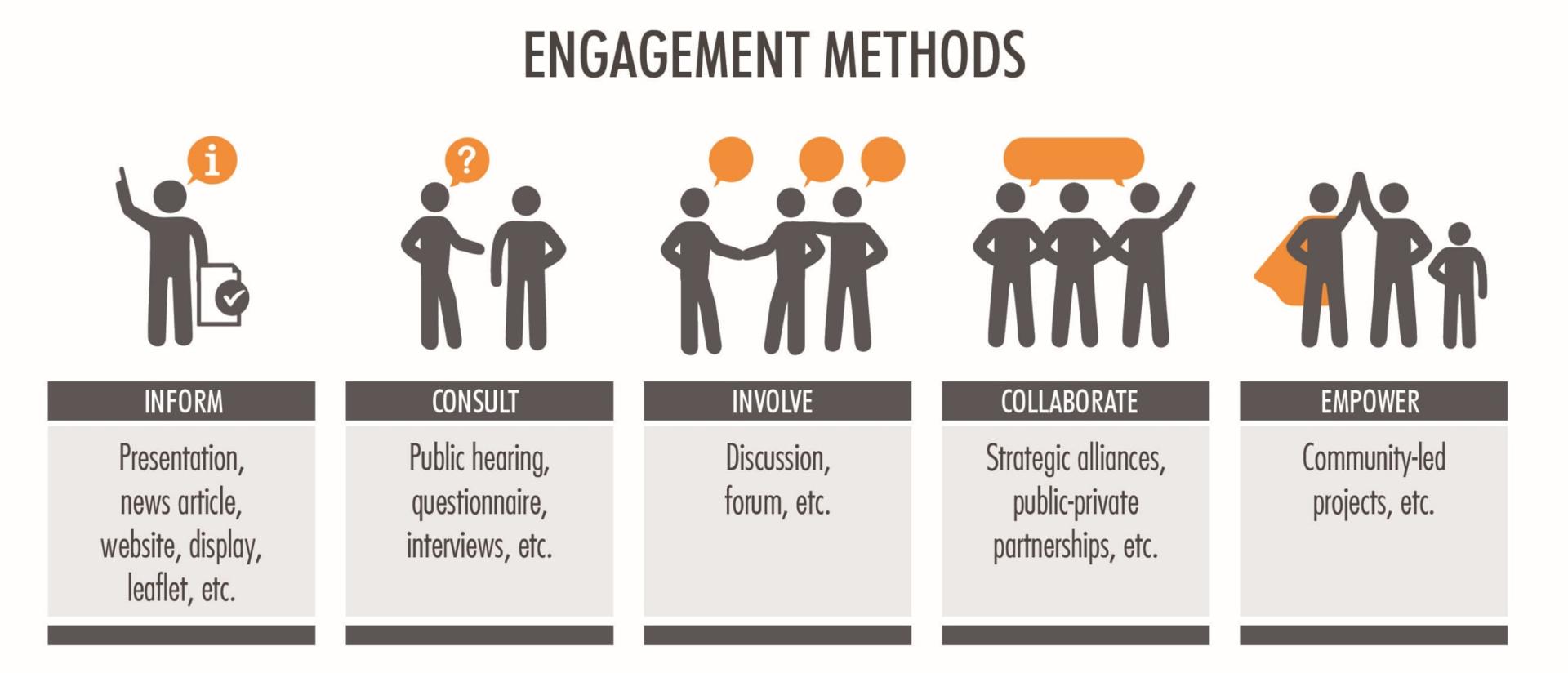
Figure 6.2. Engagement methods for rights-holders, local communities and other stakeholders. Engagement can take various forms throughout an impact assessment. Different approaches will be needed for different individuals and groups, but techniques that provide people with a more active role are generally preferable to passive provision of information.

There should be an appendix to the final impact assessment report (Section 6.11) which:

  • Lists who was consulted, and why
  • Explains the participation techniques used
  • Summarizes the consultation responses, and explains any changes made in response to these
  • Explains, where applicable, why no changes were made.