
Image

If you need to know how to
World Heritage properties must demonstrate an appropriate and effective protection and management system in order to be inscribed on the World Heritage List. The Operational Guidelines state that the purpose of a management system is to ensure the effective protection of the nominated property for present and future generations. Such a system must first and foremost ensure that all its heritage values, including its Outstanding Universal Value (OUV), are maintained (see 3.1). A management
system will also aim to ensure that the conservation of the
World Heritage property
A cultural, natural or mixed heritage place inscribed on the World Heritage List and therefore considered to be of OUV for humanity. The responsibility for nominating a property to the World Heritage List falls upon the State(s) Party(ies) where it is located. The World Heritage Committee decides whether a property should be inscribed on the World Heritage List, taking into account the technical recommendations of the Advisory Bodies following rigorous evaluation processes.
When used as a general term, World Heritage refers to all the natural, cultural and mixed properties inscribed on the World Heritage List.
generates benefits for its associated communities, and that it contributes to their well-being as well as wider societal goals, such as sustainable development, when possible.
Management
The combination of processes, activities and actions taken in relation to decision-making, planning, allocating resources, implementing and monitoring to protect a heritage place for present and future generations.
systems that explicitly integrate such aims from the outset and adopt participatory approaches are more likely to succeed through wider acceptance and support.
Each place has a unique combination of heritage values and attributes with specific conservation needs, and different ways of being able to contribute to societal needs and aspirations. Understanding this and establishing consensus around the overarching purpose of its heritage management system, provide the basis for defining management objectives for the heritage place. These objectives set the broad direction (or guiding principles) for the whole management system, including what must be
done to maintain the OUV of the
World Heritage property
A cultural, natural or mixed heritage place inscribed on the World Heritage List and therefore considered to be of OUV for humanity. The responsibility for nominating a property to the World Heritage List falls upon the State(s) Party(ies) where it is located. The World Heritage Committee decides whether a property should be inscribed on the World Heritage List, taking into account the technical recommendations of the Advisory Bodies following rigorous evaluation processes.
When used as a general term, World Heritage refers to all the natural, cultural and mixed properties inscribed on the World Heritage List.
and its overall heritage significance, what management measures are necessary to conserve the attributes, how the property can contribute to sustainable development and what benefits it aims to generate. Finally, what is undertaken in pursuit of those objectives and the means and actions applied to achieve them become the focus of everyday management.
Examples of management objectives could include: conserving in situ the fossils in a fossil deposit; maintaining the townscape of a human settlement; fostering the traditional occupations and livelihoods of communities and Indigenous Peoples associated with a cultural landscape; preserving a particular traditional building technique through its continuous use and application; or limiting access to certain areas to ensure the viability of habitats critical to a specific endangered migratory species.
For World Heritage properties, it is paramount to ensure that management objectives primarily seek to maintain the values for which they have been inscribed on the World Heritage List: their OUV. Other complementary but sometimes secondary objectives may then be added. When it comes to broader contributions to society, most heritage places should also aim, for example, to:
As noted above, maintaining heritage values, including the OUV, should be the unambiguous priority. While management objectives should not be in conflict, there may be occasions where compromises need to be made to respond to the aspirations of different actors. An example might be finely balanced decisions around the management of water catchments to protect significant marshland ecosystems while sustaining traditional livelihoods, or the need for historic buildings to meet regulatory requirements for safety while maintaining their original materials, layout and design. So, setting unambiguous and agreed management objectives, with the full and effective participation of all relevant rights-holders and stakeholders, can help to alleviate potential tensions between conservation and development.
The Operational Guidelines do not provide a definition of management systems due to the variability across all properties and there is a general tendency to use the terms ‘management systems’ and ‘management plans’ interchangeably. However, a management system is best understood as the combination of institutional structures, instruments and processes that together ensure the effective protection of the
World Heritage property
A cultural, natural or mixed heritage place inscribed on the World Heritage List and therefore considered to be of OUV for humanity. The responsibility for nominating a property to the World Heritage List falls upon the State(s) Party(ies) where it is located. The World Heritage Committee decides whether a property should be inscribed on the World Heritage List, taking into account the technical recommendations of the Advisory Bodies following rigorous evaluation processes.
When used as a general term, World Heritage refers to all the natural, cultural and mixed properties inscribed on the World Heritage List.
; whereas a management plan is an instrument that mainly
indicates how the management system works, outlines what is to be achieved and what actions need to be implemented over a certain period of time.
Possible common elements of an effective management system as noted in the Operational Guidelines are:
This list of elements is not exhaustive. In considering heritage management systems, it is important to recognize that they can have very different compositions. Most heritage management systems draw on efforts from diverse institutions and from an array of legal, customary and regulatory instruments, which can be heritage and non-heritage specific, operating at national, regional and/or local levels. In the case of World Heritage, the management system routinely includes a combination of administrative levels, since the ultimate responsibility for their protection lies with the State Party, while most management actions take place locally.
It should also be noted that at many heritage places, including World Heritage properties, elements of the management system will not always lie entirely within the heritage sector. Other sectors and their agencies, as well as civil society associations and private organizations, may have formal and informal powers over heritage and exert influence on management. For example, historic urban areas are often managed by municipal authorities, whose heritage agendas are only one small part of their mandate. Similarly, many heritage places, including some World Heritage properties, include areas that are managed by Indigenous Peoples or by religious communities.
In some cases, the management system incorporates a mix of traditional, formal and informal instruments, institutional and customary structures, practices and processes. For instance, governmental oversight can overlap with living traditions and customary management practices to protect a farming landscape or a sacred mountain.
Some management systems draw strongly on decision-making and management processes at a national level that involve certain amounts of political will and intentions; this is typical of centralized management approaches. Others may operate mostly at a provincial or local level. Often the elements of these management systems are not exclusive to one particular heritage place but cover many in one country or single jurisdiction. For instance, a heritage management unit may be responsible for managing all the designated heritage places within its jurisdiction. In a few cases, the management entity might be equipped with elements specific to a heritage place and enjoy significant management autonomy.
Even heritage places managed by a single institution will be subject to a wide array of legislation, planning instruments and institutional frameworks. The reason for this is that those places cannot exist or be managed in isolation from their surroundings. Likewise, they are influenced by the social, cultural, political, economic and environmental context that influences the ability of that single institution to operate and fulfil its mandate. For instance, a historic monument, archaeological site or
national park may have a dedicated management authority. However, other actors may govern access to those heritage places or will have legal and customary rights to use the land surrounding them in ways that may affect their protection. In the case of natural World Heritage properties, urbanization, energy and transport infrastructure and extractive industry interests in buffer zones or the wider setting are increasingly placing pressure on heritage places and important corridors for wildlife movement.
The elements of the management system are briefly summarized in the Statement of Outstanding Universal Value (SOUV) when a property is inscribed on the World Heritage List. To provide a structured way of thinking about a management system and how it functions, the following four parts of the manual explain the main elements needed to conserve a heritage place effectively:
State of Conservation reports and
Periodic Reporting
A statutory requirement of the
World Heritage Convention
The Convention Concerning the Protection of the World Cultural and Natural Heritage is an international treaty adopted by the UN in 1972 that defines the kind of natural or cultural sites which can be considered for inscription on the World Heritage List for their Outstanding Universal Value for all humankind. Commonly known as the World Heritage Convention, it establishes how the international community as a whole is responsible for
the protection of such heritage and sets out the duties of States Parties in identifying potential sites that may be eligible for inscription onto the World Heritage List and their role in protecting and preserving them. By signing the Convention, each country pledges to conserve not only the sites situated on its territory that have been recognized as being of Outstanding Universal Value, but also to protect its national heritage and to be involved in international efforts to protect, conserve and promote the heritage of humankind.
that requests
States Parties
The countries that have ratified the
World Heritage Convention
The Convention Concerning the Protection of the World Cultural and Natural Heritage is an international treaty adopted by the UN in 1972 that defines the kind of natural or cultural sites which can be considered for inscription on the World Heritage List for their Outstanding Universal Value for all humankind. Commonly known as the World Heritage Convention, it establishes how the international community as a whole is responsible for
the protection of such heritage and sets out the duties of States Parties in identifying potential sites that may be eligible for inscription onto the World Heritage List and their role in protecting and preserving them. By signing the Convention, each country pledges to conserve not only the sites situated on its territory that have been recognized as being of Outstanding Universal Value, but also to protect its national heritage and to be involved in international efforts to protect, conserve and promote the heritage of humankind.
. By ratifying the Convention, States Parties commit themselves to undertake actions directed to:identifying, knowing, protecting and promoting the cultural and natural heritage located on their territories;adopting a general policy aiming to give their cultural and natural heritage a function in the life of the community;integrating the protection of that heritage into comprehensive planning programmes;setting up services for the protection, conservation and presentation of the cultural and natural heritage with an appropriate staff and possessing the means to carry out their functions;developing scientific and technical studies and research to counteract the dangers that threaten their cultural or natural heritage;taking the appropriate legal, scientific, technical, administrative and financial measures necessary for the identification, protection, conservation, presentation and rehabilitation of their heritage;
• fostering the establishment or development of national or regional centres for
training in the protection, conservation and presentation of their cultural and
natural heritage;encouraging scientific research in this field.As members of the international community and while respecting the sovereignty of each State, States Parties to the Convention also recognize their duty to collectively contribute to the protection of the properties inscribed on the World Heritage List. Therefore, upon request by other States Parties to the
World Heritage Convention
The Convention Concerning the Protection of the World Cultural and Natural Heritage is an international treaty adopted by the UN in 1972 that defines the kind of natural or cultural sites which can be considered for inscription on the World Heritage List for their Outstanding Universal Value for all humankind. Commonly known as the World Heritage Convention, it establishes how the international community as a whole is responsible for
the protection of such heritage and sets out the duties of States Parties in identifying potential sites that may be eligible for inscription onto the World Heritage List and their role in protecting and preserving them. By signing the Convention, each country pledges to conserve not only the sites situated on its territory that have been recognized as being of Outstanding Universal Value, but also to protect its national heritage and to be involved in international efforts to protect, conserve and promote the heritage of humankind.
, they may provide their help in the identification, protection, conservation and presentation of the cultural and natural heritage located on the territory of those countries. Each State Party to the
World Heritage Convention
The Convention Concerning the Protection of the World Cultural and Natural Heritage is an international treaty adopted by the UN in 1972 that defines the kind of natural or cultural sites which can be considered for inscription on the World Heritage List for their Outstanding Universal Value for all humankind. Commonly known as the World Heritage Convention, it establishes how the international community as a whole is responsible for
the protection of such heritage and sets out the duties of States Parties in identifying potential sites that may be eligible for inscription onto the World Heritage List and their role in protecting and preserving them. By signing the Convention, each country pledges to conserve not only the sites situated on its territory that have been recognized as being of Outstanding Universal Value, but also to protect its national heritage and to be involved in international efforts to protect, conserve and promote the heritage of humankind.
undertakes not to take any deliberate measures that might damage, directly or indirectly, the cultural and natural heritage situated on the territory of other States Parties to the Convention.States Parties identify and nominate sites on their national territory to be considered for inscription on the World Heritage List. Once inscribed, States Parties assume the primary responsibility for the protection of those properties and to do all they can to achieve this purpose. They are also requested to report periodically on the state of conservation of those properties as well as on the provisions they have adopted to implement the Convention.
to submit a report usually every six years on the legislative and administrative provisions they have adopted and other actions that they have taken for the application of the Convention, including the state of conservation of the World Heritage properties located on their territories.
continuously demonstrate the lack of effective management as one of the key negative factors threatening the protection of World
Heritage
All inherited assets that people value for reasons beyond mere utility. Heritage is a broad concept and includes shared legacies from the natural environment, the creations of humans and the creations and interactions of humans and nature. It encompasses built, terrestrial, freshwater and marine environments, landscapes and seascapes, biodiversity, geodiversity, collections, cultural practices, knowledge, living experiences, etc.
. The IUCN World Heritage Outlook, which assesses all natural World
Heritage
All inherited assets that people value for reasons beyond mere utility. Heritage is a broad concept and includes shared legacies from the natural environment, the creations of humans and the creations and interactions of humans and nature. It encompasses built, terrestrial, freshwater and marine environments, landscapes and seascapes, biodiversity, geodiversity, collections, cultural practices, knowledge, living experiences, etc.
properties, has shown, for example, that only of half of these properties are considered to be managed effectively. Analysing a heritage management system according to its different elements helps to see where strengths and weaknesses lie and provides a good departure point to overcome any shortcomings. Regular assessment of how well the management system is working will also help it adapt to changes in conservation practice, availability of resources and societal aspirations over time.
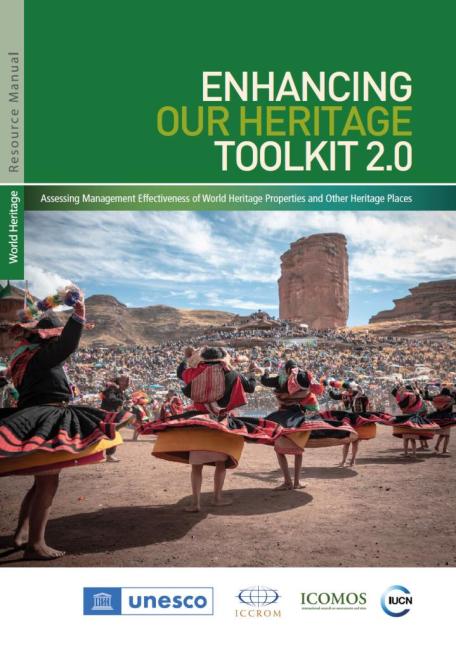
The assessment of management effectiveness has been a growing trend for many protected and conserved areas since the 1990s and in 2008 an easy-to-use framework called Enhancing Our Heritage Toolkit was launched to facilitate the evaluation of management effectiveness at natural World Heritage properties. This toolkit has since been expanded to work for all World
Heritage
All inherited assets that people value for reasons beyond mere utility. Heritage is a broad concept and includes shared legacies from the natural environment, the creations of humans and the creations and interactions of humans and nature. It encompasses built, terrestrial, freshwater and marine environments, landscapes and seascapes, biodiversity, geodiversity, collections, cultural practices, knowledge, living experiences, etc.
properties: Enhancing Our Heritage Toolkit 2.0 (EoH 2.0, 2023). The updated Toolkit provides a set of twelve tools to analyse the critical elements of a management system and should be used as a companion to this manual.