Image

If you need to know how to
The first step in the impact assessment process is to decide whether an assessment is necessary. This is known as ‘screening’ and results in a screening decision. Any proposed action should be examined as early as possible to understand whether it is likely to affect a
World Heritage property
A cultural, natural or mixed heritage place inscribed on the World Heritage List and therefore considered to be of OUV for humanity. The responsibility for nominating a property to the World Heritage List falls upon the State(s) Party(ies) where it is located. The World Heritage Committee decides whether a property should be inscribed on the World Heritage List, taking into account the technical recommendations of the Advisory Bodies following rigorous evaluation processes.
When used as a general term, World Heritage refers to all the natural, cultural and mixed properties inscribed on the World Heritage List.
’s OUV and other heritage/conservation values. When the screening process indicates that a proposed action would potentially have negative impacts, an impact assessment is required and the proponent should be encouraged to review the proposed action and revise it, if necessary, to avoid or minimize those impacts.
Screening
Screening is the first step in the impact assessment process, and helps to decide whether an assessment is necessary. When the screening process indicates that a proposed action would potentially have negative impacts on a
World Heritage property
A cultural, natural or mixed heritage place inscribed on the World Heritage List and therefore considered to be of OUV for humanity. The responsibility for nominating a property to the World Heritage List falls upon the State(s) Party(ies) where it is located. The World Heritage Committee decides whether a property should be inscribed on the World Heritage List, taking into account the technical recommendations of the Advisory Bodies following rigorous evaluation processes.
When used as a general term, World Heritage refers to all the natural, cultural and mixed properties inscribed on the World Heritage List.
’s OUV and other values, an impact assessment is required and the proponent should be encouraged to review the proposed action and revise it, if necessary, to avoid or minimize those potential impacts in the early stages.
involves consideration of the type, size and characteristics of the proposed action; the sensitivity of the receiving environment; and the types of likely impacts (Figure 6.4). It is not only large development projects, or proposed actions near a
World Heritage property
A cultural, natural or mixed heritage place inscribed on the World Heritage List and therefore considered to be of OUV for humanity. The responsibility for nominating a property to the World Heritage List falls upon the State(s) Party(ies) where it is located. The World Heritage Committee decides whether a property should be inscribed on the World Heritage List, taking into account the technical recommendations of the Advisory Bodies following rigorous evaluation processes.
When used as a general term, World Heritage refers to all the natural, cultural and mixed properties inscribed on the World Heritage List.
, that need impact assessment. As World Heritage properties are of international importance, any proposed action that may affect the property’s OUV should require an impact assessment, regardless of its size or location – within the property, its buffer zone or wider setting (see Section 3.2). A series of smaller proposed actions, while not needing impact assessment on their own, may also need to be checked for their indirect and cumulative impacts on a
World Heritage property
A cultural, natural or mixed heritage place inscribed on the World Heritage List and therefore considered to be of OUV for humanity. The responsibility for nominating a property to the World Heritage List falls upon the State(s) Party(ies) where it is located. The World Heritage Committee decides whether a property should be inscribed on the World Heritage List, taking into account the technical recommendations of the Advisory Bodies following rigorous evaluation processes.
When used as a general term, World Heritage refers to all the natural, cultural and mixed properties inscribed on the World Heritage List.
.
The screening analysis should consider whether the proposed action could affect the values and attributes that underpin OUV (see Section 3.2). Understanding a
World Heritage property
A cultural, natural or mixed heritage place inscribed on the World Heritage List and therefore considered to be of OUV for humanity. The responsibility for nominating a property to the World Heritage List falls upon the State(s) Party(ies) where it is located. The World Heritage Committee decides whether a property should be inscribed on the World Heritage List, taking into account the technical recommendations of the Advisory Bodies following rigorous evaluation processes.
When used as a general term, World Heritage refers to all the natural, cultural and mixed properties inscribed on the World Heritage List.
should therefore begin with an analysis of its Statement of Outstanding Universal Value (SOUV) to identify its values and attributes. Tool 1 provides a structured approach to identifying values and attributes based on an SOUV.
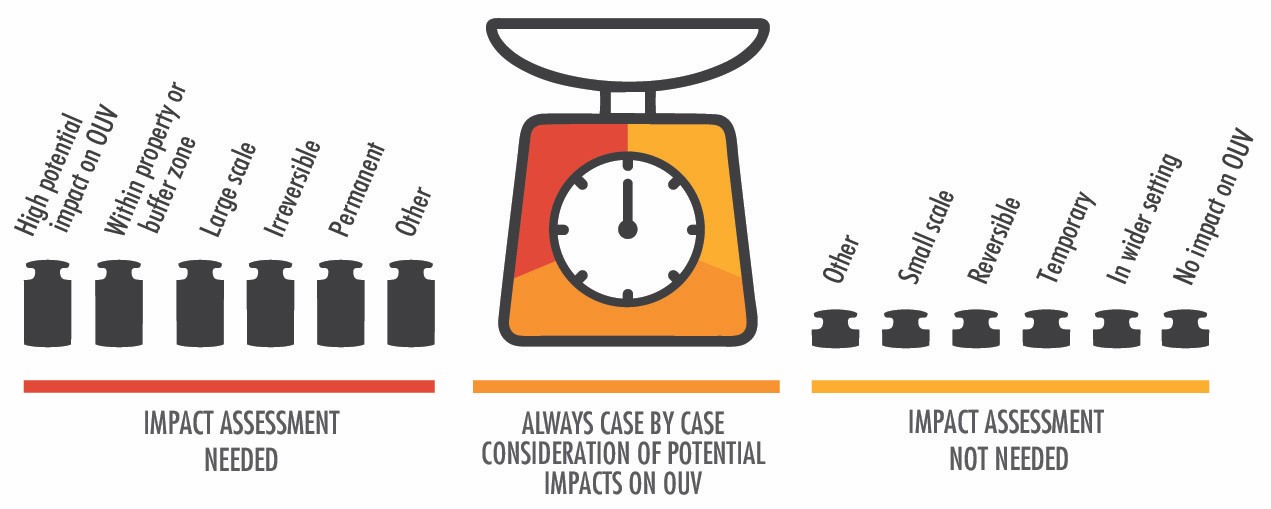
Figure 6.4. Factors that should be taken into consideration in impact assessment screening in a World Heritage All inherited assets that people value for reasons beyond mere utility. Heritage is a broad concept and includes shared legacies from the natural environment, the creations of humans and the creations and interactions of humans and nature. It encompasses built, terrestrial, freshwater and marine environments, landscapes and seascapes, biodiversity, geodiversity, collections, cultural practices, knowledge, living experiences, etc. context. Potential impacts on OUV require explicit consideration.
Where the screening stage suggests that no impact assessment is necessary, the proponent should prepare a screening report, based on existing information, that documents:
The
World Heritage Committee
The main decision-making body of the
World Heritage Convention
The Convention Concerning the Protection of the World Cultural and Natural Heritage is an international treaty adopted by the UN in 1972 that defines the kind of natural or cultural sites which can be considered for inscription on the World Heritage List for their Outstanding Universal Value for all humankind. Commonly known as the World Heritage Convention, it establishes how the international community as a whole is responsible for
the protection of such heritage and sets out the duties of States Parties in identifying potential sites that may be eligible for inscription onto the World Heritage List and their role in protecting and preserving them. By signing the Convention, each country pledges to conserve not only the sites situated on its territory that have been recognized as being of Outstanding Universal Value, but also to protect its national heritage and to be involved in international efforts to protect, conserve and promote the heritage of humankind.
, it consists of representatives from 21 of the States Parties to the Convention elected for terms up to six years, but voluntarily reduced to 4 years to ensure equitable representation.The Committee meets at least once a year. It is one of the key implementing actors of the
World Heritage Convention
The Convention Concerning the Protection of the World Cultural and Natural Heritage is an international treaty adopted by the UN in 1972 that defines the kind of natural or cultural sites which can be considered for inscription on the World Heritage List for their Outstanding Universal Value for all humankind. Commonly known as the World Heritage Convention, it establishes how the international community as a whole is responsible for
the protection of such heritage and sets out the duties of States Parties in identifying potential sites that may be eligible for inscription onto the World Heritage List and their role in protecting and preserving them. By signing the Convention, each country pledges to conserve not only the sites situated on its territory that have been recognized as being of Outstanding Universal Value, but also to protect its national heritage and to be involved in international efforts to protect, conserve and promote the heritage of humankind.
, allocates financial assistance from the
World Heritage Fund
A trust fund established according to article 15 of the World Heritage Convention in conformity with the provisions of the Financial Regulations of UNESCO to assist in the protection of properties forming part of the World Cultural and Natural Heritage of Outstanding Universal Value.The Fund for the Protection of the World Natural and Cultural Heritage of Outstanding Universal Value, commonly known as World Heritage Fund, consists of compulsory and voluntary contributions made by States Parties to the Convention, and any other resources authorized by the Fund’s regulations. These include resources received from UNESCO, UN organisations, public or private bodies or individuals, funds raised for the benefit of the Fund, any other source acceptable to the World Heritage Committee. The Fund may be used for purposes defined by the World Heritage Committee and may include studies, provision of expertise and skilled labour, training activities, low-interest or interest- free loans or, in exceptional cases and for special reasons of non- repayable subsidies for the protection, conservation, presentation and rehabilitation of the World Natural and Cultural Heritage.
and has the final say on whether a site shall be inscribed on the World Heritage List. It examines reports on the state of conservation of inscribed sites and decides on the inscription or removal of properties on the List of World Heritage in Danger.The main functions of the Convention, in cooperation with States Parties, are to:decide, on the basis of Tentative Lists and nominations submitted by States Parties, which cultural and natural properties of Outstanding Universal Value are to be inscribed on the World Heritage List and therefore protected under the Convention;examine the state of conservation of properties inscribed on the World Heritage List through processes of Reactive Monitoring and Periodic Reporting;decide which properties inscribed on the World Heritage List are to be inscribed
on, or removed from the List of World Heritage in Danger;decide whether a property should be deleted from the World Heritage List;define the procedure by which requests for International Assistance are to be
considered and carry out studies and consultations as necessary before coming to a decision;determine how the resources of the
World Heritage Fund
A trust fund established according to article 15 of the World Heritage Convention in conformity with the provisions of the Financial Regulations of UNESCO to assist in the protection of properties forming part of the World Cultural and Natural Heritage of Outstanding Universal Value.The Fund for the Protection of the World Natural and Cultural Heritage of Outstanding Universal Value, commonly known as World Heritage Fund, consists of compulsory and voluntary contributions made by States Parties to the Convention, and any other resources authorized by the Fund’s regulations. These include resources received from UNESCO, UN organisations, public or private bodies or individuals, funds raised for the benefit of the Fund, any other source acceptable to the World Heritage Committee. The Fund may be used for purposes defined by the World Heritage Committee and may include studies, provision of expertise and skilled labour, training activities, low-interest or interest- free loans or, in exceptional cases and for special reasons of non- repayable subsidies for the protection, conservation, presentation and rehabilitation of the World Natural and Cultural Heritage.
can be used most advantageously to assist States Parties in the protection of their properties of Outstanding Universal Value;seek ways to increase the
World Heritage Fund
A trust fund established according to article 15 of the World Heritage Convention in conformity with the provisions of the Financial Regulations of UNESCO to assist in the protection of properties forming part of the World Cultural and Natural Heritage of Outstanding Universal Value.The Fund for the Protection of the World Natural and Cultural Heritage of Outstanding Universal Value, commonly known as World Heritage Fund, consists of compulsory and voluntary contributions made by States Parties to the Convention, and any other resources authorized by the Fund’s regulations. These include resources received from UNESCO, UN organisations, public or private bodies or individuals, funds raised for the benefit of the Fund, any other source acceptable to the World Heritage Committee. The Fund may be used for purposes defined by the World Heritage Committee and may include studies, provision of expertise and skilled labour, training activities, low-interest or interest- free loans or, in exceptional cases and for special reasons of non- repayable subsidies for the protection, conservation, presentation and rehabilitation of the World Natural and Cultural Heritage.
;submit a report on its activities every two years to the General Assembly of States
Parties and to the UNESCO General Conference;review and evaluate periodically the implementation of the Convention;revise and adopt the Operational Guidelines.
has decided that two activities are never considered compatible with World Heritage status: extractive activities16 and the construction of dams with large reservoirs. The International Council on Mining and Metals has issued a ‘No-go commitment’ not to explore or exploit for oil, gas or minerals in World Heritage properties, and to ensure operations adjacent to World Heritage properties are not incompatible with OUV. The International Hydropower Association has similarly committed to a no-go for World Heritage and a ‘Duty of care commitment’. Leading global companies have joined this commitment, including mining, oil and gas, insurance and banks. Therefore, a recommendation not to proceed with proposed actions of this type can be made at the screening stage. In addition, any proposed dam that could affect properties located within the same river basin will always require an assessment in order to avoid impacts on OUV.
The
World Heritage Committee
The main decision-making body of the
World Heritage Convention
The Convention Concerning the Protection of the World Cultural and Natural Heritage is an international treaty adopted by the UN in 1972 that defines the kind of natural or cultural sites which can be considered for inscription on the World Heritage List for their Outstanding Universal Value for all humankind. Commonly known as the World Heritage Convention, it establishes how the international community as a whole is responsible for
the protection of such heritage and sets out the duties of States Parties in identifying potential sites that may be eligible for inscription onto the World Heritage List and their role in protecting and preserving them. By signing the Convention, each country pledges to conserve not only the sites situated on its territory that have been recognized as being of Outstanding Universal Value, but also to protect its national heritage and to be involved in international efforts to protect, conserve and promote the heritage of humankind.
, it consists of representatives from 21 of the States Parties to the Convention elected for terms up to six years, but voluntarily reduced to 4 years to ensure equitable representation.The Committee meets at least once a year. It is one of the key implementing actors of the
World Heritage Convention
The Convention Concerning the Protection of the World Cultural and Natural Heritage is an international treaty adopted by the UN in 1972 that defines the kind of natural or cultural sites which can be considered for inscription on the World Heritage List for their Outstanding Universal Value for all humankind. Commonly known as the World Heritage Convention, it establishes how the international community as a whole is responsible for
the protection of such heritage and sets out the duties of States Parties in identifying potential sites that may be eligible for inscription onto the World Heritage List and their role in protecting and preserving them. By signing the Convention, each country pledges to conserve not only the sites situated on its territory that have been recognized as being of Outstanding Universal Value, but also to protect its national heritage and to be involved in international efforts to protect, conserve and promote the heritage of humankind.
, allocates financial assistance from the
World Heritage Fund
A trust fund established according to article 15 of the World Heritage Convention in conformity with the provisions of the Financial Regulations of UNESCO to assist in the protection of properties forming part of the World Cultural and Natural Heritage of Outstanding Universal Value.The Fund for the Protection of the World Natural and Cultural Heritage of Outstanding Universal Value, commonly known as World Heritage Fund, consists of compulsory and voluntary contributions made by States Parties to the Convention, and any other resources authorized by the Fund’s regulations. These include resources received from UNESCO, UN organisations, public or private bodies or individuals, funds raised for the benefit of the Fund, any other source acceptable to the World Heritage Committee. The Fund may be used for purposes defined by the World Heritage Committee and may include studies, provision of expertise and skilled labour, training activities, low-interest or interest- free loans or, in exceptional cases and for special reasons of non- repayable subsidies for the protection, conservation, presentation and rehabilitation of the World Natural and Cultural Heritage.
and has the final say on whether a site shall be inscribed on the World Heritage List. It examines reports on the state of conservation of inscribed sites and decides on the inscription or removal of properties on the List of World Heritage in Danger.The main functions of the Convention, in cooperation with States Parties, are to:decide, on the basis of Tentative Lists and nominations submitted by States Parties, which cultural and natural properties of Outstanding Universal Value are to be inscribed on the World Heritage List and therefore protected under the Convention;examine the state of conservation of properties inscribed on the World Heritage List through processes of Reactive Monitoring and Periodic Reporting;decide which properties inscribed on the World Heritage List are to be inscribed
on, or removed from the List of World Heritage in Danger;decide whether a property should be deleted from the World Heritage List;define the procedure by which requests for International Assistance are to be
considered and carry out studies and consultations as necessary before coming to a decision;determine how the resources of the
World Heritage Fund
A trust fund established according to article 15 of the World Heritage Convention in conformity with the provisions of the Financial Regulations of UNESCO to assist in the protection of properties forming part of the World Cultural and Natural Heritage of Outstanding Universal Value.The Fund for the Protection of the World Natural and Cultural Heritage of Outstanding Universal Value, commonly known as World Heritage Fund, consists of compulsory and voluntary contributions made by States Parties to the Convention, and any other resources authorized by the Fund’s regulations. These include resources received from UNESCO, UN organisations, public or private bodies or individuals, funds raised for the benefit of the Fund, any other source acceptable to the World Heritage Committee. The Fund may be used for purposes defined by the World Heritage Committee and may include studies, provision of expertise and skilled labour, training activities, low-interest or interest- free loans or, in exceptional cases and for special reasons of non- repayable subsidies for the protection, conservation, presentation and rehabilitation of the World Natural and Cultural Heritage.
can be used most advantageously to assist States Parties in the protection of their properties of Outstanding Universal Value;seek ways to increase the
World Heritage Fund
A trust fund established according to article 15 of the World Heritage Convention in conformity with the provisions of the Financial Regulations of UNESCO to assist in the protection of properties forming part of the World Cultural and Natural Heritage of Outstanding Universal Value.The Fund for the Protection of the World Natural and Cultural Heritage of Outstanding Universal Value, commonly known as World Heritage Fund, consists of compulsory and voluntary contributions made by States Parties to the Convention, and any other resources authorized by the Fund’s regulations. These include resources received from UNESCO, UN organisations, public or private bodies or individuals, funds raised for the benefit of the Fund, any other source acceptable to the World Heritage Committee. The Fund may be used for purposes defined by the World Heritage Committee and may include studies, provision of expertise and skilled labour, training activities, low-interest or interest- free loans or, in exceptional cases and for special reasons of non- repayable subsidies for the protection, conservation, presentation and rehabilitation of the World Natural and Cultural Heritage.
;submit a report on its activities every two years to the General Assembly of States
Parties and to the UNESCO General Conference;review and evaluate periodically the implementation of the Convention;revise and adopt the Operational Guidelines.
may also request an impact assessment, for example, after it has received notification of proposed or ongoing action via the UNESCO
World Heritage Centre
The UNESCO World Heritage Centre is a technical administrative body within UNESCO, established in 1992 and appointed by the Director-General of UNESCO. It acts as the Secretariat of the
World Heritage Convention
The Convention Concerning the Protection of the World Cultural and Natural Heritage is an international treaty adopted by the UN in 1972 that defines the kind of natural or cultural sites which can be considered for inscription on the World Heritage List for their Outstanding Universal Value for all humankind. Commonly known as the World Heritage Convention, it establishes how the international community as a whole is responsible for
the protection of such heritage and sets out the duties of States Parties in identifying potential sites that may be eligible for inscription onto the World Heritage List and their role in protecting and preserving them. By signing the Convention, each country pledges to conserve not only the sites situated on its territory that have been recognized as being of Outstanding Universal Value, but also to protect its national heritage and to be involved in international efforts to protect, conserve and promote the heritage of humankind.
, is the focal point and coordinator within UNESCO for all matters related to World Heritage, and ensures the day-to-day management of the Convention.The main tasks of the World Heritage Centre are:the organization of the meetings of the General Assembly and the Committee;the implementation of decisions of the
World Heritage Committee
The main decision-making body of the
World Heritage Convention
The Convention Concerning the Protection of the World Cultural and Natural Heritage is an international treaty adopted by the UN in 1972 that defines the kind of natural or cultural sites which can be considered for inscription on the World Heritage List for their Outstanding Universal Value for all humankind. Commonly known as the World Heritage Convention, it establishes how the international community as a whole is responsible for
the protection of such heritage and sets out the duties of States Parties in identifying potential sites that may be eligible for inscription onto the World Heritage List and their role in protecting and preserving them. By signing the Convention, each country pledges to conserve not only the sites situated on its territory that have been recognized as being of Outstanding Universal Value, but also to protect its national heritage and to be involved in international efforts to protect, conserve and promote the heritage of humankind.
, it consists of representatives from 21 of the States Parties to the Convention elected for terms up to six years, but voluntarily reduced to 4 years to ensure equitable representation.The Committee meets at least once a year. It is one of the key implementing actors of the
World Heritage Convention
The Convention Concerning the Protection of the World Cultural and Natural Heritage is an international treaty adopted by the UN in 1972 that defines the kind of natural or cultural sites which can be considered for inscription on the World Heritage List for their Outstanding Universal Value for all humankind. Commonly known as the World Heritage Convention, it establishes how the international community as a whole is responsible for
the protection of such heritage and sets out the duties of States Parties in identifying potential sites that may be eligible for inscription onto the World Heritage List and their role in protecting and preserving them. By signing the Convention, each country pledges to conserve not only the sites situated on its territory that have been recognized as being of Outstanding Universal Value, but also to protect its national heritage and to be involved in international efforts to protect, conserve and promote the heritage of humankind.
, allocates financial assistance from the
World Heritage Fund
A trust fund established according to article 15 of the World Heritage Convention in conformity with the provisions of the Financial Regulations of UNESCO to assist in the protection of properties forming part of the World Cultural and Natural Heritage of Outstanding Universal Value.The Fund for the Protection of the World Natural and Cultural Heritage of Outstanding Universal Value, commonly known as World Heritage Fund, consists of compulsory and voluntary contributions made by States Parties to the Convention, and any other resources authorized by the Fund’s regulations. These include resources received from UNESCO, UN organisations, public or private bodies or individuals, funds raised for the benefit of the Fund, any other source acceptable to the World Heritage Committee. The Fund may be used for purposes defined by the World Heritage Committee and may include studies, provision of expertise and skilled labour, training activities, low-interest or interest- free loans or, in exceptional cases and for special reasons of non- repayable subsidies for the protection, conservation, presentation and rehabilitation of the World Natural and Cultural Heritage.
and has the final say on whether a site shall be inscribed on the World Heritage List. It examines reports on the state of conservation of inscribed sites and decides on the inscription or removal of properties on the List of World Heritage in Danger.The main functions of the Convention, in cooperation with States Parties, are to:decide, on the basis of Tentative Lists and nominations submitted by States Parties, which cultural and natural properties of Outstanding Universal Value are to be inscribed on the World Heritage List and therefore protected under the Convention;examine the state of conservation of properties inscribed on the World Heritage List through processes of Reactive Monitoring and Periodic Reporting;decide which properties inscribed on the World Heritage List are to be inscribed
on, or removed from the List of World Heritage in Danger;decide whether a property should be deleted from the World Heritage List;define the procedure by which requests for International Assistance are to be
considered and carry out studies and consultations as necessary before coming to a decision;determine how the resources of the
World Heritage Fund
A trust fund established according to article 15 of the World Heritage Convention in conformity with the provisions of the Financial Regulations of UNESCO to assist in the protection of properties forming part of the World Cultural and Natural Heritage of Outstanding Universal Value.The Fund for the Protection of the World Natural and Cultural Heritage of Outstanding Universal Value, commonly known as World Heritage Fund, consists of compulsory and voluntary contributions made by States Parties to the Convention, and any other resources authorized by the Fund’s regulations. These include resources received from UNESCO, UN organisations, public or private bodies or individuals, funds raised for the benefit of the Fund, any other source acceptable to the World Heritage Committee. The Fund may be used for purposes defined by the World Heritage Committee and may include studies, provision of expertise and skilled labour, training activities, low-interest or interest- free loans or, in exceptional cases and for special reasons of non- repayable subsidies for the protection, conservation, presentation and rehabilitation of the World Natural and Cultural Heritage.
can be used most advantageously to assist States Parties in the protection of their properties of Outstanding Universal Value;seek ways to increase the
World Heritage Fund
A trust fund established according to article 15 of the World Heritage Convention in conformity with the provisions of the Financial Regulations of UNESCO to assist in the protection of properties forming part of the World Cultural and Natural Heritage of Outstanding Universal Value.The Fund for the Protection of the World Natural and Cultural Heritage of Outstanding Universal Value, commonly known as World Heritage Fund, consists of compulsory and voluntary contributions made by States Parties to the Convention, and any other resources authorized by the Fund’s regulations. These include resources received from UNESCO, UN organisations, public or private bodies or individuals, funds raised for the benefit of the Fund, any other source acceptable to the World Heritage Committee. The Fund may be used for purposes defined by the World Heritage Committee and may include studies, provision of expertise and skilled labour, training activities, low-interest or interest- free loans or, in exceptional cases and for special reasons of non- repayable subsidies for the protection, conservation, presentation and rehabilitation of the World Natural and Cultural Heritage.
;submit a report on its activities every two years to the General Assembly of States
Parties and to the UNESCO General Conference;review and evaluate periodically the implementation of the Convention;revise and adopt the Operational Guidelines.
and resolutions of the General Assembly and reporting to them on their execution;the receipt, registration, checking the completeness, archiving and transmission to the relevant Advisory Bodies of nominations to the World Heritage List;the coordination of studies and activities as part of the Global Strategy for a Representative, Balanced and Credible World Heritage List;the organization of Periodic Reporting and coordination of Reactive Monitoring;the coordination of International Assistance;the mobilization of extra-budgetary resources for the conservation and management of World Heritage properties;the assistance to States Parties in the implementation of the Committee›s
programmes and projects;the promotion of World Heritage and the Convention through the dissemination of
information to States Parties, the Advisory Bodies and the general public.
, in line with Paragraph 172 or 174 of the Operational Guidelines. If the Committee requests an impact assessment, this becomes the responsibility of the State Party concerned.
States Parties
The countries that have ratified the
World Heritage Convention
The Convention Concerning the Protection of the World Cultural and Natural Heritage is an international treaty adopted by the UN in 1972 that defines the kind of natural or cultural sites which can be considered for inscription on the World Heritage List for their Outstanding Universal Value for all humankind. Commonly known as the World Heritage Convention, it establishes how the international community as a whole is responsible for
the protection of such heritage and sets out the duties of States Parties in identifying potential sites that may be eligible for inscription onto the World Heritage List and their role in protecting and preserving them. By signing the Convention, each country pledges to conserve not only the sites situated on its territory that have been recognized as being of Outstanding Universal Value, but also to protect its national heritage and to be involved in international efforts to protect, conserve and promote the heritage of humankind.
. By ratifying the Convention, States Parties commit themselves to undertake actions directed to:identifying, knowing, protecting and promoting the cultural and natural heritage located on their territories;adopting a general policy aiming to give their cultural and natural heritage a function in the life of the community;integrating the protection of that heritage into comprehensive planning programmes;setting up services for the protection, conservation and presentation of the cultural and natural heritage with an appropriate staff and possessing the means to carry out their functions;developing scientific and technical studies and research to counteract the dangers that threaten their cultural or natural heritage;taking the appropriate legal, scientific, technical, administrative and financial measures necessary for the identification, protection, conservation, presentation and rehabilitation of their heritage;
• fostering the establishment or development of national or regional centres for
training in the protection, conservation and presentation of their cultural and
natural heritage;encouraging scientific research in this field.As members of the international community and while respecting the sovereignty of each State, States Parties to the Convention also recognize their duty to collectively contribute to the protection of the properties inscribed on the World Heritage List. Therefore, upon request by other States Parties to the
World Heritage Convention
The Convention Concerning the Protection of the World Cultural and Natural Heritage is an international treaty adopted by the UN in 1972 that defines the kind of natural or cultural sites which can be considered for inscription on the World Heritage List for their Outstanding Universal Value for all humankind. Commonly known as the World Heritage Convention, it establishes how the international community as a whole is responsible for
the protection of such heritage and sets out the duties of States Parties in identifying potential sites that may be eligible for inscription onto the World Heritage List and their role in protecting and preserving them. By signing the Convention, each country pledges to conserve not only the sites situated on its territory that have been recognized as being of Outstanding Universal Value, but also to protect its national heritage and to be involved in international efforts to protect, conserve and promote the heritage of humankind.
, they may provide their help in the identification, protection, conservation and presentation of the cultural and natural heritage located on the territory of those countries. Each State Party to the
World Heritage Convention
The Convention Concerning the Protection of the World Cultural and Natural Heritage is an international treaty adopted by the UN in 1972 that defines the kind of natural or cultural sites which can be considered for inscription on the World Heritage List for their Outstanding Universal Value for all humankind. Commonly known as the World Heritage Convention, it establishes how the international community as a whole is responsible for
the protection of such heritage and sets out the duties of States Parties in identifying potential sites that may be eligible for inscription onto the World Heritage List and their role in protecting and preserving them. By signing the Convention, each country pledges to conserve not only the sites situated on its territory that have been recognized as being of Outstanding Universal Value, but also to protect its national heritage and to be involved in international efforts to protect, conserve and promote the heritage of humankind.
undertakes not to take any deliberate measures that might damage, directly or indirectly, the cultural and natural heritage situated on the territory of other States Parties to the Convention.States Parties identify and nominate sites on their national territory to be considered for inscription on the World Heritage List. Once inscribed, States Parties assume the primary responsibility for the protection of those properties and to do all they can to achieve this purpose. They are also requested to report periodically on the state of conservation of those properties as well as on the provisions they have adopted to implement the Convention.
can use the screening process as an opportunity to proactively inform the UNESCO
World Heritage Centre
The UNESCO World Heritage Centre is a technical administrative body within UNESCO, established in 1992 and appointed by the Director-General of UNESCO. It acts as the Secretariat of the
World Heritage Convention
The Convention Concerning the Protection of the World Cultural and Natural Heritage is an international treaty adopted by the UN in 1972 that defines the kind of natural or cultural sites which can be considered for inscription on the World Heritage List for their Outstanding Universal Value for all humankind. Commonly known as the World Heritage Convention, it establishes how the international community as a whole is responsible for
the protection of such heritage and sets out the duties of States Parties in identifying potential sites that may be eligible for inscription onto the World Heritage List and their role in protecting and preserving them. By signing the Convention, each country pledges to conserve not only the sites situated on its territory that have been recognized as being of Outstanding Universal Value, but also to protect its national heritage and to be involved in international efforts to protect, conserve and promote the heritage of humankind.
, is the focal point and coordinator within UNESCO for all matters related to World Heritage, and ensures the day-to-day management of the Convention.The main tasks of the World Heritage Centre are:the organization of the meetings of the General Assembly and the Committee;the implementation of decisions of the
World Heritage Committee
The main decision-making body of the
World Heritage Convention
The Convention Concerning the Protection of the World Cultural and Natural Heritage is an international treaty adopted by the UN in 1972 that defines the kind of natural or cultural sites which can be considered for inscription on the World Heritage List for their Outstanding Universal Value for all humankind. Commonly known as the World Heritage Convention, it establishes how the international community as a whole is responsible for
the protection of such heritage and sets out the duties of States Parties in identifying potential sites that may be eligible for inscription onto the World Heritage List and their role in protecting and preserving them. By signing the Convention, each country pledges to conserve not only the sites situated on its territory that have been recognized as being of Outstanding Universal Value, but also to protect its national heritage and to be involved in international efforts to protect, conserve and promote the heritage of humankind.
, it consists of representatives from 21 of the States Parties to the Convention elected for terms up to six years, but voluntarily reduced to 4 years to ensure equitable representation.The Committee meets at least once a year. It is one of the key implementing actors of the
World Heritage Convention
The Convention Concerning the Protection of the World Cultural and Natural Heritage is an international treaty adopted by the UN in 1972 that defines the kind of natural or cultural sites which can be considered for inscription on the World Heritage List for their Outstanding Universal Value for all humankind. Commonly known as the World Heritage Convention, it establishes how the international community as a whole is responsible for
the protection of such heritage and sets out the duties of States Parties in identifying potential sites that may be eligible for inscription onto the World Heritage List and their role in protecting and preserving them. By signing the Convention, each country pledges to conserve not only the sites situated on its territory that have been recognized as being of Outstanding Universal Value, but also to protect its national heritage and to be involved in international efforts to protect, conserve and promote the heritage of humankind.
, allocates financial assistance from the
World Heritage Fund
A trust fund established according to article 15 of the World Heritage Convention in conformity with the provisions of the Financial Regulations of UNESCO to assist in the protection of properties forming part of the World Cultural and Natural Heritage of Outstanding Universal Value.The Fund for the Protection of the World Natural and Cultural Heritage of Outstanding Universal Value, commonly known as World Heritage Fund, consists of compulsory and voluntary contributions made by States Parties to the Convention, and any other resources authorized by the Fund’s regulations. These include resources received from UNESCO, UN organisations, public or private bodies or individuals, funds raised for the benefit of the Fund, any other source acceptable to the World Heritage Committee. The Fund may be used for purposes defined by the World Heritage Committee and may include studies, provision of expertise and skilled labour, training activities, low-interest or interest- free loans or, in exceptional cases and for special reasons of non- repayable subsidies for the protection, conservation, presentation and rehabilitation of the World Natural and Cultural Heritage.
and has the final say on whether a site shall be inscribed on the World Heritage List. It examines reports on the state of conservation of inscribed sites and decides on the inscription or removal of properties on the List of World Heritage in Danger.The main functions of the Convention, in cooperation with States Parties, are to:decide, on the basis of Tentative Lists and nominations submitted by States Parties, which cultural and natural properties of Outstanding Universal Value are to be inscribed on the World Heritage List and therefore protected under the Convention;examine the state of conservation of properties inscribed on the World Heritage List through processes of Reactive Monitoring and Periodic Reporting;decide which properties inscribed on the World Heritage List are to be inscribed
on, or removed from the List of World Heritage in Danger;decide whether a property should be deleted from the World Heritage List;define the procedure by which requests for International Assistance are to be
considered and carry out studies and consultations as necessary before coming to a decision;determine how the resources of the
World Heritage Fund
A trust fund established according to article 15 of the World Heritage Convention in conformity with the provisions of the Financial Regulations of UNESCO to assist in the protection of properties forming part of the World Cultural and Natural Heritage of Outstanding Universal Value.The Fund for the Protection of the World Natural and Cultural Heritage of Outstanding Universal Value, commonly known as World Heritage Fund, consists of compulsory and voluntary contributions made by States Parties to the Convention, and any other resources authorized by the Fund’s regulations. These include resources received from UNESCO, UN organisations, public or private bodies or individuals, funds raised for the benefit of the Fund, any other source acceptable to the World Heritage Committee. The Fund may be used for purposes defined by the World Heritage Committee and may include studies, provision of expertise and skilled labour, training activities, low-interest or interest- free loans or, in exceptional cases and for special reasons of non- repayable subsidies for the protection, conservation, presentation and rehabilitation of the World Natural and Cultural Heritage.
can be used most advantageously to assist States Parties in the protection of their properties of Outstanding Universal Value;seek ways to increase the
World Heritage Fund
A trust fund established according to article 15 of the World Heritage Convention in conformity with the provisions of the Financial Regulations of UNESCO to assist in the protection of properties forming part of the World Cultural and Natural Heritage of Outstanding Universal Value.The Fund for the Protection of the World Natural and Cultural Heritage of Outstanding Universal Value, commonly known as World Heritage Fund, consists of compulsory and voluntary contributions made by States Parties to the Convention, and any other resources authorized by the Fund’s regulations. These include resources received from UNESCO, UN organisations, public or private bodies or individuals, funds raised for the benefit of the Fund, any other source acceptable to the World Heritage Committee. The Fund may be used for purposes defined by the World Heritage Committee and may include studies, provision of expertise and skilled labour, training activities, low-interest or interest- free loans or, in exceptional cases and for special reasons of non- repayable subsidies for the protection, conservation, presentation and rehabilitation of the World Natural and Cultural Heritage.
;submit a report on its activities every two years to the General Assembly of States
Parties and to the UNESCO General Conference;review and evaluate periodically the implementation of the Convention;revise and adopt the Operational Guidelines.
and resolutions of the General Assembly and reporting to them on their execution;the receipt, registration, checking the completeness, archiving and transmission to the relevant Advisory Bodies of nominations to the World Heritage List;the coordination of studies and activities as part of the Global Strategy for a Representative, Balanced and Credible World Heritage List;the organization of Periodic Reporting and coordination of Reactive Monitoring;the coordination of International Assistance;the mobilization of extra-budgetary resources for the conservation and management of World Heritage properties;the assistance to States Parties in the implementation of the Committee›s
programmes and projects;the promotion of World Heritage and the Convention through the dissemination of
information to States Parties, the Advisory Bodies and the general public.
of any proposed actions which may affect a property’s OUV, in line with Paragraph 172 of the Operational Guidelines (Section 3.3). The
National Focal Point
The governmental organization primarily responsible for ensuring the implementation of activities related to the Convention within their country, and which act as the communication channel between the Secretariat (
World Heritage Centre
The UNESCO World Heritage Centre is a technical administrative body within UNESCO, established in 1992 and appointed by the Director-General of UNESCO. It acts as the Secretariat of the
World Heritage Convention
The Convention Concerning the Protection of the World Cultural and Natural Heritage is an international treaty adopted by the UN in 1972 that defines the kind of natural or cultural sites which can be considered for inscription on the World Heritage List for their Outstanding Universal Value for all humankind. Commonly known as the World Heritage Convention, it establishes how the international community as a whole is responsible for
the protection of such heritage and sets out the duties of States Parties in identifying potential sites that may be eligible for inscription onto the World Heritage List and their role in protecting and preserving them. By signing the Convention, each country pledges to conserve not only the sites situated on its territory that have been recognized as being of Outstanding Universal Value, but also to protect its national heritage and to be involved in international efforts to protect, conserve and promote the heritage of humankind.
, is the focal point and coordinator within UNESCO for all matters related to World Heritage, and ensures the day-to-day management of the Convention.The main tasks of the World Heritage Centre are:the organization of the meetings of the General Assembly and the Committee;the implementation of decisions of the
World Heritage Committee
The main decision-making body of the
World Heritage Convention
The Convention Concerning the Protection of the World Cultural and Natural Heritage is an international treaty adopted by the UN in 1972 that defines the kind of natural or cultural sites which can be considered for inscription on the World Heritage List for their Outstanding Universal Value for all humankind. Commonly known as the World Heritage Convention, it establishes how the international community as a whole is responsible for
the protection of such heritage and sets out the duties of States Parties in identifying potential sites that may be eligible for inscription onto the World Heritage List and their role in protecting and preserving them. By signing the Convention, each country pledges to conserve not only the sites situated on its territory that have been recognized as being of Outstanding Universal Value, but also to protect its national heritage and to be involved in international efforts to protect, conserve and promote the heritage of humankind.
, it consists of representatives from 21 of the States Parties to the Convention elected for terms up to six years, but voluntarily reduced to 4 years to ensure equitable representation.The Committee meets at least once a year. It is one of the key implementing actors of the
World Heritage Convention
The Convention Concerning the Protection of the World Cultural and Natural Heritage is an international treaty adopted by the UN in 1972 that defines the kind of natural or cultural sites which can be considered for inscription on the World Heritage List for their Outstanding Universal Value for all humankind. Commonly known as the World Heritage Convention, it establishes how the international community as a whole is responsible for
the protection of such heritage and sets out the duties of States Parties in identifying potential sites that may be eligible for inscription onto the World Heritage List and their role in protecting and preserving them. By signing the Convention, each country pledges to conserve not only the sites situated on its territory that have been recognized as being of Outstanding Universal Value, but also to protect its national heritage and to be involved in international efforts to protect, conserve and promote the heritage of humankind.
, allocates financial assistance from the
World Heritage Fund
A trust fund established according to article 15 of the World Heritage Convention in conformity with the provisions of the Financial Regulations of UNESCO to assist in the protection of properties forming part of the World Cultural and Natural Heritage of Outstanding Universal Value.The Fund for the Protection of the World Natural and Cultural Heritage of Outstanding Universal Value, commonly known as World Heritage Fund, consists of compulsory and voluntary contributions made by States Parties to the Convention, and any other resources authorized by the Fund’s regulations. These include resources received from UNESCO, UN organisations, public or private bodies or individuals, funds raised for the benefit of the Fund, any other source acceptable to the World Heritage Committee. The Fund may be used for purposes defined by the World Heritage Committee and may include studies, provision of expertise and skilled labour, training activities, low-interest or interest- free loans or, in exceptional cases and for special reasons of non- repayable subsidies for the protection, conservation, presentation and rehabilitation of the World Natural and Cultural Heritage.
and has the final say on whether a site shall be inscribed on the World Heritage List. It examines reports on the state of conservation of inscribed sites and decides on the inscription or removal of properties on the List of World Heritage in Danger.The main functions of the Convention, in cooperation with States Parties, are to:decide, on the basis of Tentative Lists and nominations submitted by States Parties, which cultural and natural properties of Outstanding Universal Value are to be inscribed on the World Heritage List and therefore protected under the Convention;examine the state of conservation of properties inscribed on the World Heritage List through processes of Reactive Monitoring and Periodic Reporting;decide which properties inscribed on the World Heritage List are to be inscribed
on, or removed from the List of World Heritage in Danger;decide whether a property should be deleted from the World Heritage List;define the procedure by which requests for International Assistance are to be
considered and carry out studies and consultations as necessary before coming to a decision;determine how the resources of the
World Heritage Fund
A trust fund established according to article 15 of the World Heritage Convention in conformity with the provisions of the Financial Regulations of UNESCO to assist in the protection of properties forming part of the World Cultural and Natural Heritage of Outstanding Universal Value.The Fund for the Protection of the World Natural and Cultural Heritage of Outstanding Universal Value, commonly known as World Heritage Fund, consists of compulsory and voluntary contributions made by States Parties to the Convention, and any other resources authorized by the Fund’s regulations. These include resources received from UNESCO, UN organisations, public or private bodies or individuals, funds raised for the benefit of the Fund, any other source acceptable to the World Heritage Committee. The Fund may be used for purposes defined by the World Heritage Committee and may include studies, provision of expertise and skilled labour, training activities, low-interest or interest- free loans or, in exceptional cases and for special reasons of non- repayable subsidies for the protection, conservation, presentation and rehabilitation of the World Natural and Cultural Heritage.
can be used most advantageously to assist States Parties in the protection of their properties of Outstanding Universal Value;seek ways to increase the
World Heritage Fund
A trust fund established according to article 15 of the World Heritage Convention in conformity with the provisions of the Financial Regulations of UNESCO to assist in the protection of properties forming part of the World Cultural and Natural Heritage of Outstanding Universal Value.The Fund for the Protection of the World Natural and Cultural Heritage of Outstanding Universal Value, commonly known as World Heritage Fund, consists of compulsory and voluntary contributions made by States Parties to the Convention, and any other resources authorized by the Fund’s regulations. These include resources received from UNESCO, UN organisations, public or private bodies or individuals, funds raised for the benefit of the Fund, any other source acceptable to the World Heritage Committee. The Fund may be used for purposes defined by the World Heritage Committee and may include studies, provision of expertise and skilled labour, training activities, low-interest or interest- free loans or, in exceptional cases and for special reasons of non- repayable subsidies for the protection, conservation, presentation and rehabilitation of the World Natural and Cultural Heritage.
;submit a report on its activities every two years to the General Assembly of States
Parties and to the UNESCO General Conference;review and evaluate periodically the implementation of the Convention;revise and adopt the Operational Guidelines.
and resolutions of the General Assembly and reporting to them on their execution;the receipt, registration, checking the completeness, archiving and transmission to the relevant Advisory Bodies of nominations to the World Heritage List;the coordination of studies and activities as part of the Global Strategy for a Representative, Balanced and Credible World Heritage List;the organization of Periodic Reporting and coordination of Reactive Monitoring;the coordination of International Assistance;the mobilization of extra-budgetary resources for the conservation and management of World Heritage properties;the assistance to States Parties in the implementation of the Committee›s
programmes and projects;the promotion of World Heritage and the Convention through the dissemination of
information to States Parties, the Advisory Bodies and the general public.
), national public authorities and other stakeholders. The National Focal Points represent the point of contact between the Secretariat and the
States Parties
The countries that have ratified the
World Heritage Convention
The Convention Concerning the Protection of the World Cultural and Natural Heritage is an international treaty adopted by the UN in 1972 that defines the kind of natural or cultural sites which can be considered for inscription on the World Heritage List for their Outstanding Universal Value for all humankind. Commonly known as the World Heritage Convention, it establishes how the international community as a whole is responsible for
the protection of such heritage and sets out the duties of States Parties in identifying potential sites that may be eligible for inscription onto the World Heritage List and their role in protecting and preserving them. By signing the Convention, each country pledges to conserve not only the sites situated on its territory that have been recognized as being of Outstanding Universal Value, but also to protect its national heritage and to be involved in international efforts to protect, conserve and promote the heritage of humankind.
. By ratifying the Convention, States Parties commit themselves to undertake actions directed to:identifying, knowing, protecting and promoting the cultural and natural heritage located on their territories;adopting a general policy aiming to give their cultural and natural heritage a function in the life of the community;integrating the protection of that heritage into comprehensive planning programmes;setting up services for the protection, conservation and presentation of the cultural and natural heritage with an appropriate staff and possessing the means to carry out their functions;developing scientific and technical studies and research to counteract the dangers that threaten their cultural or natural heritage;taking the appropriate legal, scientific, technical, administrative and financial measures necessary for the identification, protection, conservation, presentation and rehabilitation of their heritage;
• fostering the establishment or development of national or regional centres for
training in the protection, conservation and presentation of their cultural and
natural heritage;encouraging scientific research in this field.As members of the international community and while respecting the sovereignty of each State, States Parties to the Convention also recognize their duty to collectively contribute to the protection of the properties inscribed on the World Heritage List. Therefore, upon request by other States Parties to the
World Heritage Convention
The Convention Concerning the Protection of the World Cultural and Natural Heritage is an international treaty adopted by the UN in 1972 that defines the kind of natural or cultural sites which can be considered for inscription on the World Heritage List for their Outstanding Universal Value for all humankind. Commonly known as the World Heritage Convention, it establishes how the international community as a whole is responsible for
the protection of such heritage and sets out the duties of States Parties in identifying potential sites that may be eligible for inscription onto the World Heritage List and their role in protecting and preserving them. By signing the Convention, each country pledges to conserve not only the sites situated on its territory that have been recognized as being of Outstanding Universal Value, but also to protect its national heritage and to be involved in international efforts to protect, conserve and promote the heritage of humankind.
, they may provide their help in the identification, protection, conservation and presentation of the cultural and natural heritage located on the territory of those countries. Each State Party to the
World Heritage Convention
The Convention Concerning the Protection of the World Cultural and Natural Heritage is an international treaty adopted by the UN in 1972 that defines the kind of natural or cultural sites which can be considered for inscription on the World Heritage List for their Outstanding Universal Value for all humankind. Commonly known as the World Heritage Convention, it establishes how the international community as a whole is responsible for
the protection of such heritage and sets out the duties of States Parties in identifying potential sites that may be eligible for inscription onto the World Heritage List and their role in protecting and preserving them. By signing the Convention, each country pledges to conserve not only the sites situated on its territory that have been recognized as being of Outstanding Universal Value, but also to protect its national heritage and to be involved in international efforts to protect, conserve and promote the heritage of humankind.
undertakes not to take any deliberate measures that might damage, directly or indirectly, the cultural and natural heritage situated on the territory of other States Parties to the Convention.States Parties identify and nominate sites on their national territory to be considered for inscription on the World Heritage List. Once inscribed, States Parties assume the primary responsibility for the protection of those properties and to do all they can to achieve this purpose. They are also requested to report periodically on the state of conservation of those properties as well as on the provisions they have adopted to implement the Convention.
.
is also expected to follow up on implementation of the
World Heritage Committee
The main decision-making body of the
World Heritage Convention
The Convention Concerning the Protection of the World Cultural and Natural Heritage is an international treaty adopted by the UN in 1972 that defines the kind of natural or cultural sites which can be considered for inscription on the World Heritage List for their Outstanding Universal Value for all humankind. Commonly known as the World Heritage Convention, it establishes how the international community as a whole is responsible for
the protection of such heritage and sets out the duties of States Parties in identifying potential sites that may be eligible for inscription onto the World Heritage List and their role in protecting and preserving them. By signing the Convention, each country pledges to conserve not only the sites situated on its territory that have been recognized as being of Outstanding Universal Value, but also to protect its national heritage and to be involved in international efforts to protect, conserve and promote the heritage of humankind.
, it consists of representatives from 21 of the States Parties to the Convention elected for terms up to six years, but voluntarily reduced to 4 years to ensure equitable representation.The Committee meets at least once a year. It is one of the key implementing actors of the
World Heritage Convention
The Convention Concerning the Protection of the World Cultural and Natural Heritage is an international treaty adopted by the UN in 1972 that defines the kind of natural or cultural sites which can be considered for inscription on the World Heritage List for their Outstanding Universal Value for all humankind. Commonly known as the World Heritage Convention, it establishes how the international community as a whole is responsible for
the protection of such heritage and sets out the duties of States Parties in identifying potential sites that may be eligible for inscription onto the World Heritage List and their role in protecting and preserving them. By signing the Convention, each country pledges to conserve not only the sites situated on its territory that have been recognized as being of Outstanding Universal Value, but also to protect its national heritage and to be involved in international efforts to protect, conserve and promote the heritage of humankind.
, allocates financial assistance from the
World Heritage Fund
A trust fund established according to article 15 of the World Heritage Convention in conformity with the provisions of the Financial Regulations of UNESCO to assist in the protection of properties forming part of the World Cultural and Natural Heritage of Outstanding Universal Value.The Fund for the Protection of the World Natural and Cultural Heritage of Outstanding Universal Value, commonly known as World Heritage Fund, consists of compulsory and voluntary contributions made by States Parties to the Convention, and any other resources authorized by the Fund’s regulations. These include resources received from UNESCO, UN organisations, public or private bodies or individuals, funds raised for the benefit of the Fund, any other source acceptable to the World Heritage Committee. The Fund may be used for purposes defined by the World Heritage Committee and may include studies, provision of expertise and skilled labour, training activities, low-interest or interest- free loans or, in exceptional cases and for special reasons of non- repayable subsidies for the protection, conservation, presentation and rehabilitation of the World Natural and Cultural Heritage.
and has the final say on whether a site shall be inscribed on the World Heritage List. It examines reports on the state of conservation of inscribed sites and decides on the inscription or removal of properties on the List of World Heritage in Danger.The main functions of the Convention, in cooperation with States Parties, are to:decide, on the basis of Tentative Lists and nominations submitted by States Parties, which cultural and natural properties of Outstanding Universal Value are to be inscribed on the World Heritage List and therefore protected under the Convention;examine the state of conservation of properties inscribed on the World Heritage List through processes of Reactive Monitoring and Periodic Reporting;decide which properties inscribed on the World Heritage List are to be inscribed
on, or removed from the List of World Heritage in Danger;decide whether a property should be deleted from the World Heritage List;define the procedure by which requests for International Assistance are to be
considered and carry out studies and consultations as necessary before coming to a decision;determine how the resources of the
World Heritage Fund
A trust fund established according to article 15 of the World Heritage Convention in conformity with the provisions of the Financial Regulations of UNESCO to assist in the protection of properties forming part of the World Cultural and Natural Heritage of Outstanding Universal Value.The Fund for the Protection of the World Natural and Cultural Heritage of Outstanding Universal Value, commonly known as World Heritage Fund, consists of compulsory and voluntary contributions made by States Parties to the Convention, and any other resources authorized by the Fund’s regulations. These include resources received from UNESCO, UN organisations, public or private bodies or individuals, funds raised for the benefit of the Fund, any other source acceptable to the World Heritage Committee. The Fund may be used for purposes defined by the World Heritage Committee and may include studies, provision of expertise and skilled labour, training activities, low-interest or interest- free loans or, in exceptional cases and for special reasons of non- repayable subsidies for the protection, conservation, presentation and rehabilitation of the World Natural and Cultural Heritage.
can be used most advantageously to assist States Parties in the protection of their properties of Outstanding Universal Value;seek ways to increase the
World Heritage Fund
A trust fund established according to article 15 of the World Heritage Convention in conformity with the provisions of the Financial Regulations of UNESCO to assist in the protection of properties forming part of the World Cultural and Natural Heritage of Outstanding Universal Value.The Fund for the Protection of the World Natural and Cultural Heritage of Outstanding Universal Value, commonly known as World Heritage Fund, consists of compulsory and voluntary contributions made by States Parties to the Convention, and any other resources authorized by the Fund’s regulations. These include resources received from UNESCO, UN organisations, public or private bodies or individuals, funds raised for the benefit of the Fund, any other source acceptable to the World Heritage Committee. The Fund may be used for purposes defined by the World Heritage Committee and may include studies, provision of expertise and skilled labour, training activities, low-interest or interest- free loans or, in exceptional cases and for special reasons of non- repayable subsidies for the protection, conservation, presentation and rehabilitation of the World Natural and Cultural Heritage.
;submit a report on its activities every two years to the General Assembly of States
Parties and to the UNESCO General Conference;review and evaluate periodically the implementation of the Convention;revise and adopt the Operational Guidelines.
Decisions and Recommendations of the
Advisory Bodies
The three international organizations which are named in the
World Heritage Convention
The Convention Concerning the Protection of the World Cultural and Natural Heritage is an international treaty adopted by the UN in 1972 that defines the kind of natural or cultural sites which can be considered for inscription on the World Heritage List for their Outstanding Universal Value for all humankind. Commonly known as the World Heritage Convention, it establishes how the international community as a whole is responsible for
the protection of such heritage and sets out the duties of States Parties in identifying potential sites that may be eligible for inscription onto the World Heritage List and their role in protecting and preserving them. By signing the Convention, each country pledges to conserve not only the sites situated on its territory that have been recognized as being of Outstanding Universal Value, but also to protect its national heritage and to be involved in international efforts to protect, conserve and promote the heritage of humankind.
to advise the
World Heritage Committee
The main decision-making body of the
World Heritage Convention
The Convention Concerning the Protection of the World Cultural and Natural Heritage is an international treaty adopted by the UN in 1972 that defines the kind of natural or cultural sites which can be considered for inscription on the World Heritage List for their Outstanding Universal Value for all humankind. Commonly known as the World Heritage Convention, it establishes how the international community as a whole is responsible for
the protection of such heritage and sets out the duties of States Parties in identifying potential sites that may be eligible for inscription onto the World Heritage List and their role in protecting and preserving them. By signing the Convention, each country pledges to conserve not only the sites situated on its territory that have been recognized as being of Outstanding Universal Value, but also to protect its national heritage and to be involved in international efforts to protect, conserve and promote the heritage of humankind.
, it consists of representatives from 21 of the States Parties to the Convention elected for terms up to six years, but voluntarily reduced to 4 years to ensure equitable representation.The Committee meets at least once a year. It is one of the key implementing actors of the
World Heritage Convention
The Convention Concerning the Protection of the World Cultural and Natural Heritage is an international treaty adopted by the UN in 1972 that defines the kind of natural or cultural sites which can be considered for inscription on the World Heritage List for their Outstanding Universal Value for all humankind. Commonly known as the World Heritage Convention, it establishes how the international community as a whole is responsible for
the protection of such heritage and sets out the duties of States Parties in identifying potential sites that may be eligible for inscription onto the World Heritage List and their role in protecting and preserving them. By signing the Convention, each country pledges to conserve not only the sites situated on its territory that have been recognized as being of Outstanding Universal Value, but also to protect its national heritage and to be involved in international efforts to protect, conserve and promote the heritage of humankind.
, allocates financial assistance from the
World Heritage Fund
A trust fund established according to article 15 of the World Heritage Convention in conformity with the provisions of the Financial Regulations of UNESCO to assist in the protection of properties forming part of the World Cultural and Natural Heritage of Outstanding Universal Value.The Fund for the Protection of the World Natural and Cultural Heritage of Outstanding Universal Value, commonly known as World Heritage Fund, consists of compulsory and voluntary contributions made by States Parties to the Convention, and any other resources authorized by the Fund’s regulations. These include resources received from UNESCO, UN organisations, public or private bodies or individuals, funds raised for the benefit of the Fund, any other source acceptable to the World Heritage Committee. The Fund may be used for purposes defined by the World Heritage Committee and may include studies, provision of expertise and skilled labour, training activities, low-interest or interest- free loans or, in exceptional cases and for special reasons of non- repayable subsidies for the protection, conservation, presentation and rehabilitation of the World Natural and Cultural Heritage.
and has the final say on whether a site shall be inscribed on the World Heritage List. It examines reports on the state of conservation of inscribed sites and decides on the inscription or removal of properties on the List of World Heritage in Danger.The main functions of the Convention, in cooperation with States Parties, are to:decide, on the basis of Tentative Lists and nominations submitted by States Parties, which cultural and natural properties of Outstanding Universal Value are to be inscribed on the World Heritage List and therefore protected under the Convention;examine the state of conservation of properties inscribed on the World Heritage List through processes of Reactive Monitoring and Periodic Reporting;decide which properties inscribed on the World Heritage List are to be inscribed
on, or removed from the List of World Heritage in Danger;decide whether a property should be deleted from the World Heritage List;define the procedure by which requests for International Assistance are to be
considered and carry out studies and consultations as necessary before coming to a decision;determine how the resources of the
World Heritage Fund
A trust fund established according to article 15 of the World Heritage Convention in conformity with the provisions of the Financial Regulations of UNESCO to assist in the protection of properties forming part of the World Cultural and Natural Heritage of Outstanding Universal Value.The Fund for the Protection of the World Natural and Cultural Heritage of Outstanding Universal Value, commonly known as World Heritage Fund, consists of compulsory and voluntary contributions made by States Parties to the Convention, and any other resources authorized by the Fund’s regulations. These include resources received from UNESCO, UN organisations, public or private bodies or individuals, funds raised for the benefit of the Fund, any other source acceptable to the World Heritage Committee. The Fund may be used for purposes defined by the World Heritage Committee and may include studies, provision of expertise and skilled labour, training activities, low-interest or interest- free loans or, in exceptional cases and for special reasons of non- repayable subsidies for the protection, conservation, presentation and rehabilitation of the World Natural and Cultural Heritage.
can be used most advantageously to assist States Parties in the protection of their properties of Outstanding Universal Value;seek ways to increase the
World Heritage Fund
A trust fund established according to article 15 of the World Heritage Convention in conformity with the provisions of the Financial Regulations of UNESCO to assist in the protection of properties forming part of the World Cultural and Natural Heritage of Outstanding Universal Value.The Fund for the Protection of the World Natural and Cultural Heritage of Outstanding Universal Value, commonly known as World Heritage Fund, consists of compulsory and voluntary contributions made by States Parties to the Convention, and any other resources authorized by the Fund’s regulations. These include resources received from UNESCO, UN organisations, public or private bodies or individuals, funds raised for the benefit of the Fund, any other source acceptable to the World Heritage Committee. The Fund may be used for purposes defined by the World Heritage Committee and may include studies, provision of expertise and skilled labour, training activities, low-interest or interest- free loans or, in exceptional cases and for special reasons of non- repayable subsidies for the protection, conservation, presentation and rehabilitation of the World Natural and Cultural Heritage.
;submit a report on its activities every two years to the General Assembly of States
Parties and to the UNESCO General Conference;review and evaluate periodically the implementation of the Convention;revise and adopt the Operational Guidelines.
in its deliberations are
ICCROM
The International Centre for the Study of the Preservation and Restoration of Cultural Property (ICCROM) is an intergovernmental organization created to promote the conservation of all forms of cultural heritage worldwide. Its headquarters are located in Rome, Italy.Its mission is to provide Member States with the best tools, knowledge, skills and enabling environment to preserve their cultural heritage in all of its forms, for the benefit of all people. It achieves this by working with institutions and professionals on the ground, nationally and internationally along three lines of action:studying and promoting cultural heritage conservation;mobilizing and coordinating expertise to address critical issues of conservation;providing the training and research tools for implementation to strengthen the
professional community.
(International Centre for the Study of the Preservation and Restoration of Cultural Property),
ICOMOS
The International Council on Monuments and Sites (ICOMOS) is an international nongovernmental organization bringing together cultural heritage professionals from across the world. Its headquarters are located in Charenton le Pont, near Paris, France.ICOMOS was founded in 1965 after the adoption of the Venice Charter, in order to promote the doctrine and the techniques of conservation. It advises the
World Heritage Committee
The main decision-making body of the
World Heritage Convention
The Convention Concerning the Protection of the World Cultural and Natural Heritage is an international treaty adopted by the UN in 1972 that defines the kind of natural or cultural sites which can be considered for inscription on the World Heritage List for their Outstanding Universal Value for all humankind. Commonly known as the World Heritage Convention, it establishes how the international community as a whole is responsible for
the protection of such heritage and sets out the duties of States Parties in identifying potential sites that may be eligible for inscription onto the World Heritage List and their role in protecting and preserving them. By signing the Convention, each country pledges to conserve not only the sites situated on its territory that have been recognized as being of Outstanding Universal Value, but also to protect its national heritage and to be involved in international efforts to protect, conserve and promote the heritage of humankind.
, it consists of representatives from 21 of the States Parties to the Convention elected for terms up to six years, but voluntarily reduced to 4 years to ensure equitable representation.The Committee meets at least once a year. It is one of the key implementing actors of the
World Heritage Convention
The Convention Concerning the Protection of the World Cultural and Natural Heritage is an international treaty adopted by the UN in 1972 that defines the kind of natural or cultural sites which can be considered for inscription on the World Heritage List for their Outstanding Universal Value for all humankind. Commonly known as the World Heritage Convention, it establishes how the international community as a whole is responsible for
the protection of such heritage and sets out the duties of States Parties in identifying potential sites that may be eligible for inscription onto the World Heritage List and their role in protecting and preserving them. By signing the Convention, each country pledges to conserve not only the sites situated on its territory that have been recognized as being of Outstanding Universal Value, but also to protect its national heritage and to be involved in international efforts to protect, conserve and promote the heritage of humankind.
, allocates financial assistance from the
World Heritage Fund
A trust fund established according to article 15 of the World Heritage Convention in conformity with the provisions of the Financial Regulations of UNESCO to assist in the protection of properties forming part of the World Cultural and Natural Heritage of Outstanding Universal Value.The Fund for the Protection of the World Natural and Cultural Heritage of Outstanding Universal Value, commonly known as World Heritage Fund, consists of compulsory and voluntary contributions made by States Parties to the Convention, and any other resources authorized by the Fund’s regulations. These include resources received from UNESCO, UN organisations, public or private bodies or individuals, funds raised for the benefit of the Fund, any other source acceptable to the World Heritage Committee. The Fund may be used for purposes defined by the World Heritage Committee and may include studies, provision of expertise and skilled labour, training activities, low-interest or interest- free loans or, in exceptional cases and for special reasons of non- repayable subsidies for the protection, conservation, presentation and rehabilitation of the World Natural and Cultural Heritage.
and has the final say on whether a site shall be inscribed on the World Heritage List. It examines reports on the state of conservation of inscribed sites and decides on the inscription or removal of properties on the List of World Heritage in Danger.The main functions of the Convention, in cooperation with States Parties, are to:decide, on the basis of Tentative Lists and nominations submitted by States Parties, which cultural and natural properties of Outstanding Universal Value are to be inscribed on the World Heritage List and therefore protected under the Convention;examine the state of conservation of properties inscribed on the World Heritage List through processes of Reactive Monitoring and Periodic Reporting;decide which properties inscribed on the World Heritage List are to be inscribed
on, or removed from the List of World Heritage in Danger;decide whether a property should be deleted from the World Heritage List;define the procedure by which requests for International Assistance are to be
considered and carry out studies and consultations as necessary before coming to a decision;determine how the resources of the
World Heritage Fund
A trust fund established according to article 15 of the World Heritage Convention in conformity with the provisions of the Financial Regulations of UNESCO to assist in the protection of properties forming part of the World Cultural and Natural Heritage of Outstanding Universal Value.The Fund for the Protection of the World Natural and Cultural Heritage of Outstanding Universal Value, commonly known as World Heritage Fund, consists of compulsory and voluntary contributions made by States Parties to the Convention, and any other resources authorized by the Fund’s regulations. These include resources received from UNESCO, UN organisations, public or private bodies or individuals, funds raised for the benefit of the Fund, any other source acceptable to the World Heritage Committee. The Fund may be used for purposes defined by the World Heritage Committee and may include studies, provision of expertise and skilled labour, training activities, low-interest or interest- free loans or, in exceptional cases and for special reasons of non- repayable subsidies for the protection, conservation, presentation and rehabilitation of the World Natural and Cultural Heritage.
can be used most advantageously to assist States Parties in the protection of their properties of Outstanding Universal Value;seek ways to increase the
World Heritage Fund
A trust fund established according to article 15 of the World Heritage Convention in conformity with the provisions of the Financial Regulations of UNESCO to assist in the protection of properties forming part of the World Cultural and Natural Heritage of Outstanding Universal Value.The Fund for the Protection of the World Natural and Cultural Heritage of Outstanding Universal Value, commonly known as World Heritage Fund, consists of compulsory and voluntary contributions made by States Parties to the Convention, and any other resources authorized by the Fund’s regulations. These include resources received from UNESCO, UN organisations, public or private bodies or individuals, funds raised for the benefit of the Fund, any other source acceptable to the World Heritage Committee. The Fund may be used for purposes defined by the World Heritage Committee and may include studies, provision of expertise and skilled labour, training activities, low-interest or interest- free loans or, in exceptional cases and for special reasons of non- repayable subsidies for the protection, conservation, presentation and rehabilitation of the World Natural and Cultural Heritage.
;submit a report on its activities every two years to the General Assembly of States
Parties and to the UNESCO General Conference;review and evaluate periodically the implementation of the Convention;revise and adopt the Operational Guidelines.
by carrying out technical evaluations of properties with cultural values proposed for inscription on the World Heritage List, as well as with comparative studies, technical assistance and reporting on the state of conservation of inscribed properties. In order to tackle the numerous facets of immovable cultural heritage and to develop the necessary scientific knowledge and methodological approaches for its protection, conservation and interpretation, ICOMOS has established scientific international committees on various cultural heritage themes and issues. The international scientific committees are ICOMOS technical bodies. As such, they undertake research, develop conservation theory, guidelines and charters, foster training for better heritage conservation, promote international exchange of scientific information and carry out common projects.
(International Council on Monuments and Sites) and
IUCN
The International Union for Conservation of Nature (IUCN) is an international membership association composed of both government and civil society organizations. It harnesses the experience, resources and reach of its member organizations and the input of its experts to promote nature conservation and accelerate the transition to sustainable development. The headquarters of the IUCN Secretariat are located in Gland, Switzerland.Created in 1948, IUCN has evolved into the world’s largest environmental network: IUCN experts are organized into six commissions dedicated to species survival, environmental law, protected areas, social and economic policy, ecosystem management and education and communication.
(International Union for Conservation of Nature).
The Advisory Bodies have the following functions:
Advise on the implementation of the
World Heritage Convention
The Convention Concerning the Protection of the World Cultural and Natural Heritage is an international treaty adopted by the UN in 1972 that defines the kind of natural or cultural sites which can be considered for inscription on the World Heritage List for their Outstanding Universal Value for all humankind. Commonly known as the World Heritage Convention, it establishes how the international community as a whole is responsible for
the protection of such heritage and sets out the duties of States Parties in identifying potential sites that may be eligible for inscription onto the World Heritage List and their role in protecting and preserving them. By signing the Convention, each country pledges to conserve not only the sites situated on its territory that have been recognized as being of Outstanding Universal Value, but also to protect its national heritage and to be involved in international efforts to protect, conserve and promote the heritage of humankind.
in the field of their expertise
Provide expert advice on how to conserve and manage properties included on the World Heritage List
Assist the
World Heritage Centre
The UNESCO World Heritage Centre is a technical administrative body within UNESCO, established in 1992 and appointed by the Director-General of UNESCO. It acts as the Secretariat of the
World Heritage Convention
The Convention Concerning the Protection of the World Cultural and Natural Heritage is an international treaty adopted by the UN in 1972 that defines the kind of natural or cultural sites which can be considered for inscription on the World Heritage List for their Outstanding Universal Value for all humankind. Commonly known as the World Heritage Convention, it establishes how the international community as a whole is responsible for
the protection of such heritage and sets out the duties of States Parties in identifying potential sites that may be eligible for inscription onto the World Heritage List and their role in protecting and preserving them. By signing the Convention, each country pledges to conserve not only the sites situated on its territory that have been recognized as being of Outstanding Universal Value, but also to protect its national heritage and to be involved in international efforts to protect, conserve and promote the heritage of humankind.
, is the focal point and coordinator within UNESCO for all matters related to World Heritage, and ensures the day-to-day management of the Convention.The main tasks of the World Heritage Centre are:the organization of the meetings of the General Assembly and the Committee;the implementation of decisions of the
World Heritage Committee
The main decision-making body of the
World Heritage Convention
The Convention Concerning the Protection of the World Cultural and Natural Heritage is an international treaty adopted by the UN in 1972 that defines the kind of natural or cultural sites which can be considered for inscription on the World Heritage List for their Outstanding Universal Value for all humankind. Commonly known as the World Heritage Convention, it establishes how the international community as a whole is responsible for
the protection of such heritage and sets out the duties of States Parties in identifying potential sites that may be eligible for inscription onto the World Heritage List and their role in protecting and preserving them. By signing the Convention, each country pledges to conserve not only the sites situated on its territory that have been recognized as being of Outstanding Universal Value, but also to protect its national heritage and to be involved in international efforts to protect, conserve and promote the heritage of humankind.
, it consists of representatives from 21 of the States Parties to the Convention elected for terms up to six years, but voluntarily reduced to 4 years to ensure equitable representation.The Committee meets at least once a year. It is one of the key implementing actors of the
World Heritage Convention
The Convention Concerning the Protection of the World Cultural and Natural Heritage is an international treaty adopted by the UN in 1972 that defines the kind of natural or cultural sites which can be considered for inscription on the World Heritage List for their Outstanding Universal Value for all humankind. Commonly known as the World Heritage Convention, it establishes how the international community as a whole is responsible for
the protection of such heritage and sets out the duties of States Parties in identifying potential sites that may be eligible for inscription onto the World Heritage List and their role in protecting and preserving them. By signing the Convention, each country pledges to conserve not only the sites situated on its territory that have been recognized as being of Outstanding Universal Value, but also to protect its national heritage and to be involved in international efforts to protect, conserve and promote the heritage of humankind.
, allocates financial assistance from the
World Heritage Fund
A trust fund established according to article 15 of the World Heritage Convention in conformity with the provisions of the Financial Regulations of UNESCO to assist in the protection of properties forming part of the World Cultural and Natural Heritage of Outstanding Universal Value.The Fund for the Protection of the World Natural and Cultural Heritage of Outstanding Universal Value, commonly known as World Heritage Fund, consists of compulsory and voluntary contributions made by States Parties to the Convention, and any other resources authorized by the Fund’s regulations. These include resources received from UNESCO, UN organisations, public or private bodies or individuals, funds raised for the benefit of the Fund, any other source acceptable to the World Heritage Committee. The Fund may be used for purposes defined by the World Heritage Committee and may include studies, provision of expertise and skilled labour, training activities, low-interest or interest- free loans or, in exceptional cases and for special reasons of non- repayable subsidies for the protection, conservation, presentation and rehabilitation of the World Natural and Cultural Heritage.
and has the final say on whether a site shall be inscribed on the World Heritage List. It examines reports on the state of conservation of inscribed sites and decides on the inscription or removal of properties on the List of World Heritage in Danger.The main functions of the Convention, in cooperation with States Parties, are to:decide, on the basis of Tentative Lists and nominations submitted by States Parties, which cultural and natural properties of Outstanding Universal Value are to be inscribed on the World Heritage List and therefore protected under the Convention;examine the state of conservation of properties inscribed on the World Heritage List through processes of Reactive Monitoring and Periodic Reporting;decide which properties inscribed on the World Heritage List are to be inscribed
on, or removed from the List of World Heritage in Danger;decide whether a property should be deleted from the World Heritage List;define the procedure by which requests for International Assistance are to be
considered and carry out studies and consultations as necessary before coming to a decision;determine how the resources of the
World Heritage Fund
A trust fund established according to article 15 of the World Heritage Convention in conformity with the provisions of the Financial Regulations of UNESCO to assist in the protection of properties forming part of the World Cultural and Natural Heritage of Outstanding Universal Value.The Fund for the Protection of the World Natural and Cultural Heritage of Outstanding Universal Value, commonly known as World Heritage Fund, consists of compulsory and voluntary contributions made by States Parties to the Convention, and any other resources authorized by the Fund’s regulations. These include resources received from UNESCO, UN organisations, public or private bodies or individuals, funds raised for the benefit of the Fund, any other source acceptable to the World Heritage Committee. The Fund may be used for purposes defined by the World Heritage Committee and may include studies, provision of expertise and skilled labour, training activities, low-interest or interest- free loans or, in exceptional cases and for special reasons of non- repayable subsidies for the protection, conservation, presentation and rehabilitation of the World Natural and Cultural Heritage.
can be used most advantageously to assist States Parties in the protection of their properties of Outstanding Universal Value;seek ways to increase the
World Heritage Fund
A trust fund established according to article 15 of the World Heritage Convention in conformity with the provisions of the Financial Regulations of UNESCO to assist in the protection of properties forming part of the World Cultural and Natural Heritage of Outstanding Universal Value.The Fund for the Protection of the World Natural and Cultural Heritage of Outstanding Universal Value, commonly known as World Heritage Fund, consists of compulsory and voluntary contributions made by States Parties to the Convention, and any other resources authorized by the Fund’s regulations. These include resources received from UNESCO, UN organisations, public or private bodies or individuals, funds raised for the benefit of the Fund, any other source acceptable to the World Heritage Committee. The Fund may be used for purposes defined by the World Heritage Committee and may include studies, provision of expertise and skilled labour, training activities, low-interest or interest- free loans or, in exceptional cases and for special reasons of non- repayable subsidies for the protection, conservation, presentation and rehabilitation of the World Natural and Cultural Heritage.
;submit a report on its activities every two years to the General Assembly of States
Parties and to the UNESCO General Conference;review and evaluate periodically the implementation of the Convention;revise and adopt the Operational Guidelines.
and resolutions of the General Assembly and reporting to them on their execution;the receipt, registration, checking the completeness, archiving and transmission to the relevant Advisory Bodies of nominations to the World Heritage List;the coordination of studies and activities as part of the Global Strategy for a Representative, Balanced and Credible World Heritage List;the organization of Periodic Reporting and coordination of Reactive Monitoring;the coordination of International Assistance;the mobilization of extra-budgetary resources for the conservation and management of World Heritage properties;the assistance to States Parties in the implementation of the Committee›s
programmes and projects;the promotion of World Heritage and the Convention through the dissemination of
information to States Parties, the Advisory Bodies and the general public.
in preparing the Committee’s documentation, the agendas of its meetings and in implementing the Committee’s decisions
Assist with the development and implementation of the Global Strategy for a Representative, Balanced and Credible World Heritage List, the World Heritage
Capacity
A combination of all the strengths and resources available within a community, society or organization that can reduce the level of risk or the effects of a disaster on a heritage place in a sustainable manner. Capacity may include physical, institutional, social or economic means as well as skilled personal or collective attributes such as leadership and management.
Building Strategy,
Periodic Reporting
A statutory requirement of the
World Heritage Convention
The Convention Concerning the Protection of the World Cultural and Natural Heritage is an international treaty adopted by the UN in 1972 that defines the kind of natural or cultural sites which can be considered for inscription on the World Heritage List for their Outstanding Universal Value for all humankind. Commonly known as the World Heritage Convention, it establishes how the international community as a whole is responsible for
the protection of such heritage and sets out the duties of States Parties in identifying potential sites that may be eligible for inscription onto the World Heritage List and their role in protecting and preserving them. By signing the Convention, each country pledges to conserve not only the sites situated on its territory that have been recognized as being of Outstanding Universal Value, but also to protect its national heritage and to be involved in international efforts to protect, conserve and promote the heritage of humankind.
that requests
States Parties
The countries that have ratified the
World Heritage Convention
The Convention Concerning the Protection of the World Cultural and Natural Heritage is an international treaty adopted by the UN in 1972 that defines the kind of natural or cultural sites which can be considered for inscription on the World Heritage List for their Outstanding Universal Value for all humankind. Commonly known as the World Heritage Convention, it establishes how the international community as a whole is responsible for
the protection of such heritage and sets out the duties of States Parties in identifying potential sites that may be eligible for inscription onto the World Heritage List and their role in protecting and preserving them. By signing the Convention, each country pledges to conserve not only the sites situated on its territory that have been recognized as being of Outstanding Universal Value, but also to protect its national heritage and to be involved in international efforts to protect, conserve and promote the heritage of humankind.
. By ratifying the Convention, States Parties commit themselves to undertake actions directed to:identifying, knowing, protecting and promoting the cultural and natural heritage located on their territories;adopting a general policy aiming to give their cultural and natural heritage a function in the life of the community;integrating the protection of that heritage into comprehensive planning programmes;setting up services for the protection, conservation and presentation of the cultural and natural heritage with an appropriate staff and possessing the means to carry out their functions;developing scientific and technical studies and research to counteract the dangers that threaten their cultural or natural heritage;taking the appropriate legal, scientific, technical, administrative and financial measures necessary for the identification, protection, conservation, presentation and rehabilitation of their heritage;
• fostering the establishment or development of national or regional centres for
training in the protection, conservation and presentation of their cultural and
natural heritage;encouraging scientific research in this field.As members of the international community and while respecting the sovereignty of each State, States Parties to the Convention also recognize their duty to collectively contribute to the protection of the properties inscribed on the World Heritage List. Therefore, upon request by other States Parties to the
World Heritage Convention
The Convention Concerning the Protection of the World Cultural and Natural Heritage is an international treaty adopted by the UN in 1972 that defines the kind of natural or cultural sites which can be considered for inscription on the World Heritage List for their Outstanding Universal Value for all humankind. Commonly known as the World Heritage Convention, it establishes how the international community as a whole is responsible for
the protection of such heritage and sets out the duties of States Parties in identifying potential sites that may be eligible for inscription onto the World Heritage List and their role in protecting and preserving them. By signing the Convention, each country pledges to conserve not only the sites situated on its territory that have been recognized as being of Outstanding Universal Value, but also to protect its national heritage and to be involved in international efforts to protect, conserve and promote the heritage of humankind.
, they may provide their help in the identification, protection, conservation and presentation of the cultural and natural heritage located on the territory of those countries. Each State Party to the
World Heritage Convention
The Convention Concerning the Protection of the World Cultural and Natural Heritage is an international treaty adopted by the UN in 1972 that defines the kind of natural or cultural sites which can be considered for inscription on the World Heritage List for their Outstanding Universal Value for all humankind. Commonly known as the World Heritage Convention, it establishes how the international community as a whole is responsible for
the protection of such heritage and sets out the duties of States Parties in identifying potential sites that may be eligible for inscription onto the World Heritage List and their role in protecting and preserving them. By signing the Convention, each country pledges to conserve not only the sites situated on its territory that have been recognized as being of Outstanding Universal Value, but also to protect its national heritage and to be involved in international efforts to protect, conserve and promote the heritage of humankind.
undertakes not to take any deliberate measures that might damage, directly or indirectly, the cultural and natural heritage situated on the territory of other States Parties to the Convention.States Parties identify and nominate sites on their national territory to be considered for inscription on the World Heritage List. Once inscribed, States Parties assume the primary responsibility for the protection of those properties and to do all they can to achieve this purpose. They are also requested to report periodically on the state of conservation of those properties as well as on the provisions they have adopted to implement the Convention.
to submit a report usually every six years on the legislative and administrative provisions they have adopted and other actions that they have taken for the application of the Convention, including the state of conservation of the World Heritage properties located on their territories.
, and the strengthening of the effective use of the
World Heritage Fund
A trust fund established according to article 15 of the World Heritage Convention in conformity with the provisions of the Financial Regulations of UNESCO to assist in the protection of properties forming part of the World Cultural and Natural Heritage of Outstanding Universal Value.The Fund for the Protection of the World Natural and Cultural Heritage of Outstanding Universal Value, commonly known as World Heritage Fund, consists of compulsory and voluntary contributions made by States Parties to the Convention, and any other resources authorized by the Fund’s regulations. These include resources received from UNESCO, UN organisations, public or private bodies or individuals, funds raised for the benefit of the Fund, any other source acceptable to the World Heritage Committee. The Fund may be used for purposes defined by the World Heritage Committee and may include studies, provision of expertise and skilled labour, training activities, low-interest or interest- free loans or, in exceptional cases and for special reasons of non- repayable subsidies for the protection, conservation, presentation and rehabilitation of the World Natural and Cultural Heritage.
Monitor the state of conservation of World Heritage properties (including through Reactive
Monitoring
Collecting and analysing data to check that the management system of a heritage place is operating effectively and delivering the right results, and to identify remedial measures in the event of shortcomings or new opportunities.
missions at the request of the Committee and Advisory missions at the invitation of the
States Parties
The countries that have ratified the
World Heritage Convention
The Convention Concerning the Protection of the World Cultural and Natural Heritage is an international treaty adopted by the UN in 1972 that defines the kind of natural or cultural sites which can be considered for inscription on the World Heritage List for their Outstanding Universal Value for all humankind. Commonly known as the World Heritage Convention, it establishes how the international community as a whole is responsible for
the protection of such heritage and sets out the duties of States Parties in identifying potential sites that may be eligible for inscription onto the World Heritage List and their role in protecting and preserving them. By signing the Convention, each country pledges to conserve not only the sites situated on its territory that have been recognized as being of Outstanding Universal Value, but also to protect its national heritage and to be involved in international efforts to protect, conserve and promote the heritage of humankind.
. By ratifying the Convention, States Parties commit themselves to undertake actions directed to:identifying, knowing, protecting and promoting the cultural and natural heritage located on their territories;adopting a general policy aiming to give their cultural and natural heritage a function in the life of the community;integrating the protection of that heritage into comprehensive planning programmes;setting up services for the protection, conservation and presentation of the cultural and natural heritage with an appropriate staff and possessing the means to carry out their functions;developing scientific and technical studies and research to counteract the dangers that threaten their cultural or natural heritage;taking the appropriate legal, scientific, technical, administrative and financial measures necessary for the identification, protection, conservation, presentation and rehabilitation of their heritage;
• fostering the establishment or development of national or regional centres for
training in the protection, conservation and presentation of their cultural and
natural heritage;encouraging scientific research in this field.As members of the international community and while respecting the sovereignty of each State, States Parties to the Convention also recognize their duty to collectively contribute to the protection of the properties inscribed on the World Heritage List. Therefore, upon request by other States Parties to the
World Heritage Convention
The Convention Concerning the Protection of the World Cultural and Natural Heritage is an international treaty adopted by the UN in 1972 that defines the kind of natural or cultural sites which can be considered for inscription on the World Heritage List for their Outstanding Universal Value for all humankind. Commonly known as the World Heritage Convention, it establishes how the international community as a whole is responsible for
the protection of such heritage and sets out the duties of States Parties in identifying potential sites that may be eligible for inscription onto the World Heritage List and their role in protecting and preserving them. By signing the Convention, each country pledges to conserve not only the sites situated on its territory that have been recognized as being of Outstanding Universal Value, but also to protect its national heritage and to be involved in international efforts to protect, conserve and promote the heritage of humankind.
, they may provide their help in the identification, protection, conservation and presentation of the cultural and natural heritage located on the territory of those countries. Each State Party to the
World Heritage Convention
The Convention Concerning the Protection of the World Cultural and Natural Heritage is an international treaty adopted by the UN in 1972 that defines the kind of natural or cultural sites which can be considered for inscription on the World Heritage List for their Outstanding Universal Value for all humankind. Commonly known as the World Heritage Convention, it establishes how the international community as a whole is responsible for
the protection of such heritage and sets out the duties of States Parties in identifying potential sites that may be eligible for inscription onto the World Heritage List and their role in protecting and preserving them. By signing the Convention, each country pledges to conserve not only the sites situated on its territory that have been recognized as being of Outstanding Universal Value, but also to protect its national heritage and to be involved in international efforts to protect, conserve and promote the heritage of humankind.
undertakes not to take any deliberate measures that might damage, directly or indirectly, the cultural and natural heritage situated on the territory of other States Parties to the Convention.States Parties identify and nominate sites on their national territory to be considered for inscription on the World Heritage List. Once inscribed, States Parties assume the primary responsibility for the protection of those properties and to do all they can to achieve this purpose. They are also requested to report periodically on the state of conservation of those properties as well as on the provisions they have adopted to implement the Convention.
)
Review requests for International Assistance
Attend meetings of the
World Heritage Committee
The main decision-making body of the
World Heritage Convention
The Convention Concerning the Protection of the World Cultural and Natural Heritage is an international treaty adopted by the UN in 1972 that defines the kind of natural or cultural sites which can be considered for inscription on the World Heritage List for their Outstanding Universal Value for all humankind. Commonly known as the World Heritage Convention, it establishes how the international community as a whole is responsible for
the protection of such heritage and sets out the duties of States Parties in identifying potential sites that may be eligible for inscription onto the World Heritage List and their role in protecting and preserving them. By signing the Convention, each country pledges to conserve not only the sites situated on its territory that have been recognized as being of Outstanding Universal Value, but also to protect its national heritage and to be involved in international efforts to protect, conserve and promote the heritage of humankind.
, it consists of representatives from 21 of the States Parties to the Convention elected for terms up to six years, but voluntarily reduced to 4 years to ensure equitable representation.The Committee meets at least once a year. It is one of the key implementing actors of the
World Heritage Convention
The Convention Concerning the Protection of the World Cultural and Natural Heritage is an international treaty adopted by the UN in 1972 that defines the kind of natural or cultural sites which can be considered for inscription on the World Heritage List for their Outstanding Universal Value for all humankind. Commonly known as the World Heritage Convention, it establishes how the international community as a whole is responsible for
the protection of such heritage and sets out the duties of States Parties in identifying potential sites that may be eligible for inscription onto the World Heritage List and their role in protecting and preserving them. By signing the Convention, each country pledges to conserve not only the sites situated on its territory that have been recognized as being of Outstanding Universal Value, but also to protect its national heritage and to be involved in international efforts to protect, conserve and promote the heritage of humankind.
, allocates financial assistance from the
World Heritage Fund
A trust fund established according to article 15 of the World Heritage Convention in conformity with the provisions of the Financial Regulations of UNESCO to assist in the protection of properties forming part of the World Cultural and Natural Heritage of Outstanding Universal Value.The Fund for the Protection of the World Natural and Cultural Heritage of Outstanding Universal Value, commonly known as World Heritage Fund, consists of compulsory and voluntary contributions made by States Parties to the Convention, and any other resources authorized by the Fund’s regulations. These include resources received from UNESCO, UN organisations, public or private bodies or individuals, funds raised for the benefit of the Fund, any other source acceptable to the World Heritage Committee. The Fund may be used for purposes defined by the World Heritage Committee and may include studies, provision of expertise and skilled labour, training activities, low-interest or interest- free loans or, in exceptional cases and for special reasons of non- repayable subsidies for the protection, conservation, presentation and rehabilitation of the World Natural and Cultural Heritage.
and has the final say on whether a site shall be inscribed on the World Heritage List. It examines reports on the state of conservation of inscribed sites and decides on the inscription or removal of properties on the List of World Heritage in Danger.The main functions of the Convention, in cooperation with States Parties, are to:decide, on the basis of Tentative Lists and nominations submitted by States Parties, which cultural and natural properties of Outstanding Universal Value are to be inscribed on the World Heritage List and therefore protected under the Convention;examine the state of conservation of properties inscribed on the World Heritage List through processes of Reactive Monitoring and Periodic Reporting;decide which properties inscribed on the World Heritage List are to be inscribed
on, or removed from the List of World Heritage in Danger;decide whether a property should be deleted from the World Heritage List;define the procedure by which requests for International Assistance are to be
considered and carry out studies and consultations as necessary before coming to a decision;determine how the resources of the
World Heritage Fund
A trust fund established according to article 15 of the World Heritage Convention in conformity with the provisions of the Financial Regulations of UNESCO to assist in the protection of properties forming part of the World Cultural and Natural Heritage of Outstanding Universal Value.The Fund for the Protection of the World Natural and Cultural Heritage of Outstanding Universal Value, commonly known as World Heritage Fund, consists of compulsory and voluntary contributions made by States Parties to the Convention, and any other resources authorized by the Fund’s regulations. These include resources received from UNESCO, UN organisations, public or private bodies or individuals, funds raised for the benefit of the Fund, any other source acceptable to the World Heritage Committee. The Fund may be used for purposes defined by the World Heritage Committee and may include studies, provision of expertise and skilled labour, training activities, low-interest or interest- free loans or, in exceptional cases and for special reasons of non- repayable subsidies for the protection, conservation, presentation and rehabilitation of the World Natural and Cultural Heritage.
can be used most advantageously to assist States Parties in the protection of their properties of Outstanding Universal Value;seek ways to increase the
World Heritage Fund
A trust fund established according to article 15 of the World Heritage Convention in conformity with the provisions of the Financial Regulations of UNESCO to assist in the protection of properties forming part of the World Cultural and Natural Heritage of Outstanding Universal Value.The Fund for the Protection of the World Natural and Cultural Heritage of Outstanding Universal Value, commonly known as World Heritage Fund, consists of compulsory and voluntary contributions made by States Parties to the Convention, and any other resources authorized by the Fund’s regulations. These include resources received from UNESCO, UN organisations, public or private bodies or individuals, funds raised for the benefit of the Fund, any other source acceptable to the World Heritage Committee. The Fund may be used for purposes defined by the World Heritage Committee and may include studies, provision of expertise and skilled labour, training activities, low-interest or interest- free loans or, in exceptional cases and for special reasons of non- repayable subsidies for the protection, conservation, presentation and rehabilitation of the World Natural and Cultural Heritage.
;submit a report on its activities every two years to the General Assembly of States
Parties and to the UNESCO General Conference;review and evaluate periodically the implementation of the Convention;revise and adopt the Operational Guidelines.
and the Bureau in an advisory capacity.
The Advisory Bodies are involved in the review of proposed actions and and any related impact assessments when they are requested by the
World Heritage Committee
The main decision-making body of the
World Heritage Convention
The Convention Concerning the Protection of the World Cultural and Natural Heritage is an international treaty adopted by the UN in 1972 that defines the kind of natural or cultural sites which can be considered for inscription on the World Heritage List for their Outstanding Universal Value for all humankind. Commonly known as the World Heritage Convention, it establishes how the international community as a whole is responsible for
the protection of such heritage and sets out the duties of States Parties in identifying potential sites that may be eligible for inscription onto the World Heritage List and their role in protecting and preserving them. By signing the Convention, each country pledges to conserve not only the sites situated on its territory that have been recognized as being of Outstanding Universal Value, but also to protect its national heritage and to be involved in international efforts to protect, conserve and promote the heritage of humankind.
, it consists of representatives from 21 of the States Parties to the Convention elected for terms up to six years, but voluntarily reduced to 4 years to ensure equitable representation.The Committee meets at least once a year. It is one of the key implementing actors of the
World Heritage Convention
The Convention Concerning the Protection of the World Cultural and Natural Heritage is an international treaty adopted by the UN in 1972 that defines the kind of natural or cultural sites which can be considered for inscription on the World Heritage List for their Outstanding Universal Value for all humankind. Commonly known as the World Heritage Convention, it establishes how the international community as a whole is responsible for
the protection of such heritage and sets out the duties of States Parties in identifying potential sites that may be eligible for inscription onto the World Heritage List and their role in protecting and preserving them. By signing the Convention, each country pledges to conserve not only the sites situated on its territory that have been recognized as being of Outstanding Universal Value, but also to protect its national heritage and to be involved in international efforts to protect, conserve and promote the heritage of humankind.
, allocates financial assistance from the
World Heritage Fund
A trust fund established according to article 15 of the World Heritage Convention in conformity with the provisions of the Financial Regulations of UNESCO to assist in the protection of properties forming part of the World Cultural and Natural Heritage of Outstanding Universal Value.The Fund for the Protection of the World Natural and Cultural Heritage of Outstanding Universal Value, commonly known as World Heritage Fund, consists of compulsory and voluntary contributions made by States Parties to the Convention, and any other resources authorized by the Fund’s regulations. These include resources received from UNESCO, UN organisations, public or private bodies or individuals, funds raised for the benefit of the Fund, any other source acceptable to the World Heritage Committee. The Fund may be used for purposes defined by the World Heritage Committee and may include studies, provision of expertise and skilled labour, training activities, low-interest or interest- free loans or, in exceptional cases and for special reasons of non- repayable subsidies for the protection, conservation, presentation and rehabilitation of the World Natural and Cultural Heritage.
and has the final say on whether a site shall be inscribed on the World Heritage List. It examines reports on the state of conservation of inscribed sites and decides on the inscription or removal of properties on the List of World Heritage in Danger.The main functions of the Convention, in cooperation with States Parties, are to:decide, on the basis of Tentative Lists and nominations submitted by States Parties, which cultural and natural properties of Outstanding Universal Value are to be inscribed on the World Heritage List and therefore protected under the Convention;examine the state of conservation of properties inscribed on the World Heritage List through processes of Reactive Monitoring and Periodic Reporting;decide which properties inscribed on the World Heritage List are to be inscribed
on, or removed from the List of World Heritage in Danger;decide whether a property should be deleted from the World Heritage List;define the procedure by which requests for International Assistance are to be
considered and carry out studies and consultations as necessary before coming to a decision;determine how the resources of the
World Heritage Fund
A trust fund established according to article 15 of the World Heritage Convention in conformity with the provisions of the Financial Regulations of UNESCO to assist in the protection of properties forming part of the World Cultural and Natural Heritage of Outstanding Universal Value.The Fund for the Protection of the World Natural and Cultural Heritage of Outstanding Universal Value, commonly known as World Heritage Fund, consists of compulsory and voluntary contributions made by States Parties to the Convention, and any other resources authorized by the Fund’s regulations. These include resources received from UNESCO, UN organisations, public or private bodies or individuals, funds raised for the benefit of the Fund, any other source acceptable to the World Heritage Committee. The Fund may be used for purposes defined by the World Heritage Committee and may include studies, provision of expertise and skilled labour, training activities, low-interest or interest- free loans or, in exceptional cases and for special reasons of non- repayable subsidies for the protection, conservation, presentation and rehabilitation of the World Natural and Cultural Heritage.
can be used most advantageously to assist States Parties in the protection of their properties of Outstanding Universal Value;seek ways to increase the
World Heritage Fund
A trust fund established according to article 15 of the World Heritage Convention in conformity with the provisions of the Financial Regulations of UNESCO to assist in the protection of properties forming part of the World Cultural and Natural Heritage of Outstanding Universal Value.The Fund for the Protection of the World Natural and Cultural Heritage of Outstanding Universal Value, commonly known as World Heritage Fund, consists of compulsory and voluntary contributions made by States Parties to the Convention, and any other resources authorized by the Fund’s regulations. These include resources received from UNESCO, UN organisations, public or private bodies or individuals, funds raised for the benefit of the Fund, any other source acceptable to the World Heritage Committee. The Fund may be used for purposes defined by the World Heritage Committee and may include studies, provision of expertise and skilled labour, training activities, low-interest or interest- free loans or, in exceptional cases and for special reasons of non- repayable subsidies for the protection, conservation, presentation and rehabilitation of the World Natural and Cultural Heritage.
;submit a report on its activities every two years to the General Assembly of States
Parties and to the UNESCO General Conference;review and evaluate periodically the implementation of the Convention;revise and adopt the Operational Guidelines.
.
in this regard.