
Image

If you need to know how to
If impacts are negligible, they may need no mitigation. In all other cases, mitigation should be considered to avoid or minimize any negative impacts (Section 6.3), and the revised proposed action together with its mitigation measures needs to be re-assessed (Section 6.8). This makes impact assessment an iterative process, with final predictions that include the planned mitigation measures.
A ‘mitigation hierarchy’ is often used in impact assessment, ranging from the preferred ‘avoidance’, through ‘minimize’, ‘rectify’ and ‘reduce’ to ‘offset’ (Figure 6.10). However, in the case of World Heritage, OUV is irreplaceable and cannot be ‘offset’. The best outcome for World Heritage is to avoid negative impacts entirely – this includes the dismissal of the proposed action, or its relocation away from the
. However, it may involve creative problem-solving to re-think and potentially redesign the proposed action or identify measures that avoid negative impacts. In some cases, it may not be possible to entirely avoid all negative impacts but they should be minimized to acceptable levels that cause no concern for World Heritage by significantly reducing their magnitude, duration, extent, etc.
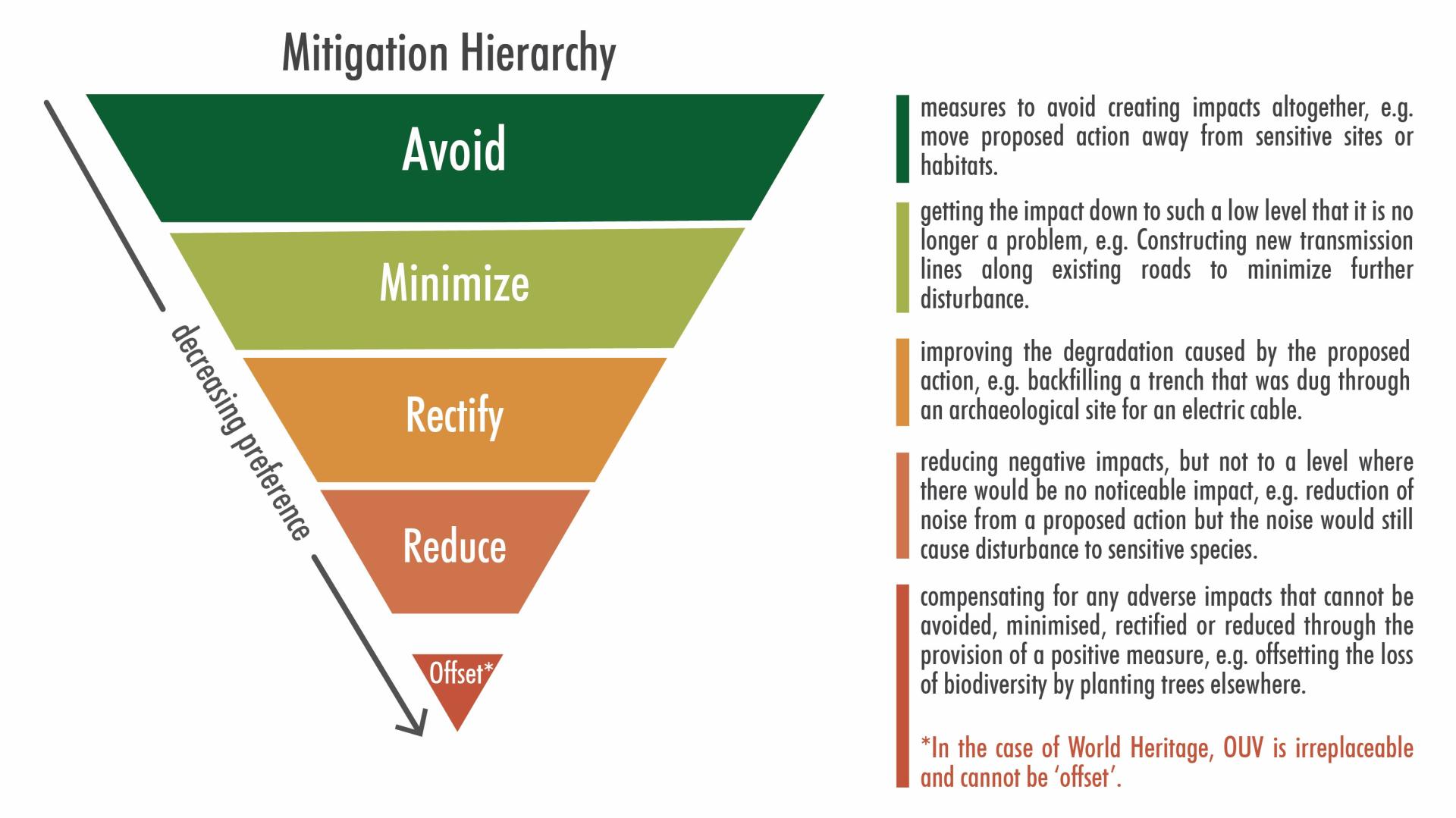
Figure 6.10. The Mitigation Hierarchy.
Box 6.5. Examples of avoidance and minimization of negative impacts
Examples of avoidance of negative impacts include:
● Not undertaking a proposed action
● Selecting a different location or route away from the
● Maintaining a buffer zone between (parts of) the proposed action and attributes
● Eliminating a particularly problematic element of the proposed action
Examples of minimization of negative impacts include:
● Reducing the scale of a proposed action
● Selecting a different location or route
● Reducing noise or vibrations from a proposed action to such a level that it does not cause
disturbance
● Redesigning elements of the proposed action
● Using different technologies
Once mitigation measures have been identified, it is important that they are included in the revised proposed action, which should then be re-evaluated. Any residual negative impacts – those impacts that would still affect the even after mitigation has taken place – then need to be addressed. Further mitigation measures may be needed. If significant residual negative impacts on OUV cannot be avoided, the impact assessment report should recommend that the proposed action should not be taken forward.
While avoiding negative impacts is at the heart of impact assessment, best practice in impact assessment takes a more proactive and positive approach: proponents should not only aim to ‘do no harm’, but seek to actively ‘do good’ while not compromising OUV. The commitment of to integrate a sustainable development perspective into all World processes (Section 3.4) means that impact assessment offers an opportunity to enhance the positive impacts of a proposed action, or create new ones, for the benefit of both heritage and society (see Box 6.6).
Box 6.6. Examples of enhancement of positive impacts
Examples of enhancement of positive impacts (where this does not impinge on OUV) include:
● Employing local residents, training them and involving them in the management of the project or
● Enhancing biodiversity by linking ‘green’ areas via wildlife corridors
● Providing health, community or educational facilities in areas where these are needed
● Remediating contaminated land
● Removing inappropriate interventions such as unsympathetic building additions or impediments to significant views
● Improving human well-being and air quality through new parks and walking/cycling facilities
The proposed action may also be able to reduce the impact on the of external or cumulative changes and disasters. For instance, it may stabilize unsteady ground to reduce erosion at a geologically fragile (UNESCO, 2010).
The section of the impact assessment report containing mitigation recommendations should become a living document that can be used by all parties as the project moves through different stages of implementation, even by those who were not involved in the original impact assessment. This ensures that mitigation measures are understood and implemented by all and can be monitored.
The impact assessment needs to clearly state:
In most cases, the proponent will be responsible for these actions. The impact assessment recommendations should be provided in a form that can be readily incorporated into an implementation strategy (Section 6.14). For example, they might become part of the commitments made by a project proponent, or used by the relevant authorities to set mandatory conditions for approval which the proponent is obliged to adopt when permission is granted. They should be clearly stated, measurable and binding. To help ensure that mitigation and enhancement take place as required, the impact assessment report should show clear connections between the recommendations and the subsequent steps of decision-making, implementation of the proposed action, and monitoring (Figure 6.11).
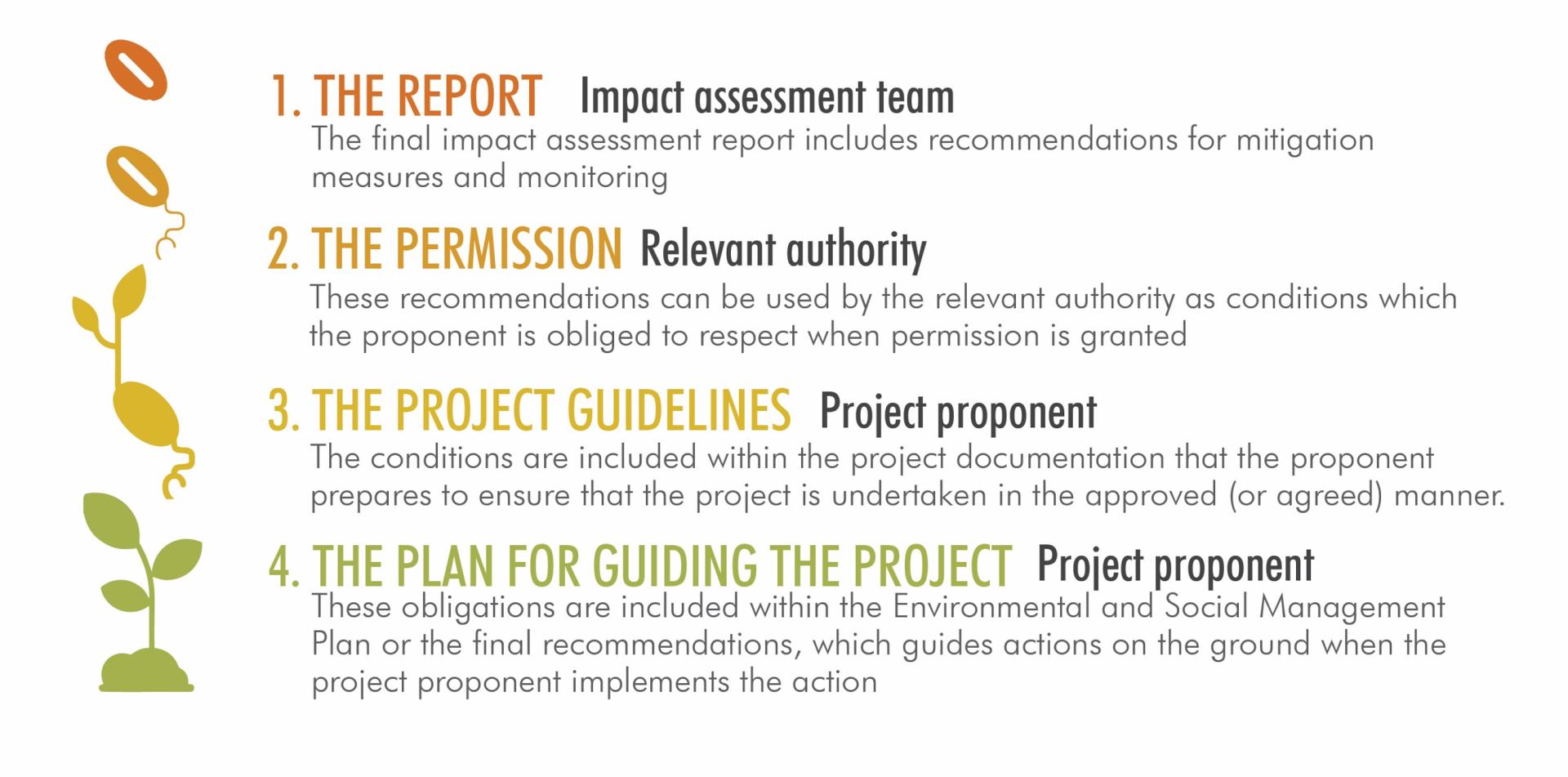
Figure 6.11. Taking into account the report’s recommendations in each step of decision-making and implementation. In order for the impact assessment to ensure that the proposed action is taken forward in the best possible way for World , the recommendations should be taken into consideration at each subsequent step of decision-making and implementation.