

Image

If you need to know how to
Identifying and predicting impacts is a technical step at the heart of the impact assessment process and therefore needs specialist contributions from a range of relevant disciplines. At a minimum, it is advisable to confirm the results of the impact prediction and evaluation – and mitigation measures for any significant negative impacts – with the environmental and heritage authorities. and other stakeholders should preferably be involved in these stages.
identification brings together information about the attributes of OUV and other heritage/conservation values (Section 6.6) and the proposed action and alternatives (Section 6.3 and Section 6.7), to determine what would happen to the attributes of a if a proposed action took place – for example, Figure 6.7 shows how noise from a proposed action might impact on nesting birds. An impact is the interaction of the proposed action with an attribute of the , and this can take either negative or positive forms – biophysical, social, cultural, economic, health, visual, etc. All relevant impacts should be considered, including those on intangible attributes which are reflected in physical elements of the property (Figure 6.9).

Figure 6.7. The impact on nesting birds created by noise from a proposed action. An impact is the interaction of the proposed action with an attribute of the
. In this example, the noise from a proposed action may impact on nesting birds, which when disturbed will leave the area. Where birds are an attribute of the
, this would lead to a loss of Outstanding Universal Value.

Figure 6.8. The impact on a historic urban environment created by sound and vibration from a proposed action. An impact is the interaction of the proposed action with an attribute of the . In this example, the vibration from a proposed action may have an impact on the buildings and weaken their structural stability. Where these buildings are an attribute of the , this would lead to a loss of Outstanding Universal Value.

Figure 6.9. Examples of elements of a heritage place that could be impacted. A proposed action can significantly affect many attributes of a , and the impact assessment will need to consider all relevant impacts on these.
The proposed action can directly impact on the ’s OUV and other heritage/conservation values. It can also have indirect impacts, where a direct impact has follow-on impacts (e.g. more traffic, leading to air pollution, which could then have further follow-on indirect impacts on human health or vegetation). These also need to be formally identified and assessed. The impacts of a proposed action may also combine with those of other past, existing or future actions and other factors (such as climate change) that may affect a , and have a cumulative impact. There may have been changes at or near the since the time of its inscription that need to be taken into consideration when assessing a new proposal. The proposed action may create a precedent which then creates cumulative impacts in the future. For this reason, it is important to be aware of other actions and trends in the past, present and future, and not consider a proposed action in isolation. When cumulative impacts are significant, the final impact assessment report will need a separate section to address them clearly.
Box 6.4. Examples of different impacts
Examples of direct impacts include:
Examples of indirect impacts include:
Examples of cumulative impacts include:
When identifying impacts on OUV, it is important to remain aware of how a
is interconnected with its buffer zone and wider setting, and that it cannot be viewed in isolation. All direct, indirect and cumulative impacts occurring in the entire area of influence of the proposed action need to be identified and assessed for their potential to impact the
.
Impacts may occur at any stage of a proposed action, so the action’s entire life cycle needs to be considered (Figure 6.5). For instance, construction may involve a limited number of heavy goods vehicle movements, while operation may involve a larger number of car movements. Many impact assessments have a separate chapter or sections on construction impacts.
While professional judgement can often be used to identify the impacts of a proposed action, there are a number of tools that can help ensure that all the issues are considered in a more systematic way. These include:
Once potential impacts have been identified, an informed prediction can be made about the likely scale and nature of those impacts. The impact prediction should compare the baseline conditions of the
(Section 6.6) against the situation with the proposed action; this should be done for each reasonable alternative as well as the proposed action. This is a technical step and its conclusions should be defendable.
Predictions of potential impacts can include a range of characteristics (Table 6.2). It may be possible to quantify the impact (e.g. likely changes to the population of a sensitive species, or number/area of historic structures that are to be altered); in other cases, a narrative description may be the only option. In all cases, the description of the impact should be as precise as possible. Assumptions underlying the predictions should be clearly disclosed and uncertainties described.
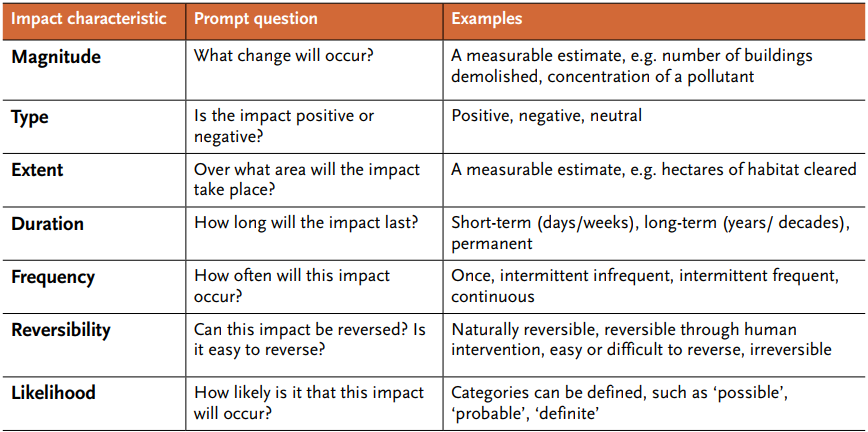
Table 6.2. Characteristics of potential impacts and prompt questions as part of an impact assessment
Tool 3 provides a structure for predicting impacts, taking into account the characteristics in Table 6.2. While recognizing that some uncertainty will be unavoidable, the prediction should provide as solid and transparent a basis as possible on which to make decisions. Techniques for impact prediction include:
Predicting impacts quantitatively can allow clear comparisons between the likely future with and without the proposed action, and between the impacts of the proposed action and any alternatives. However, where this is difficult, impacts can be estimated using, for example, ‘high’, ‘medium’ and ‘low’ categories. If there is a high degree of uncertainty, it may also be useful to provide best- and worst-case predictions. Such approaches, including any definitions of the categories used, should be explained clearly in the final report (Section 6.11).
aims to help protect the natural and cultural environment, and therefore emphasizes negative impacts. However, impacts can be positive, and these should also be identified and predicted.
This allows an understanding of: