
Image

If you need to know how to
Being included on the World Heritage List means that a heritage place has been formally recognized as having ‘Outstanding Universal Value’ (OUV). The concept of OUV, together with the conditions for its authenticity and integrity, underpins the , and all activities associated with properties on the List, including impact assessment (Figure 3.1). Each property on the List has a Statement of Outstanding Universal Value which summarizes the justification for the inscription of the property on the World Heritage List, and serves as a baseline for the universally recognized and accepted heritage/conservation values of that place. These statements can be found on the UNESCO ’s website along with other relevant documents, such as the nomination file, management plans, and mission reports, among others.
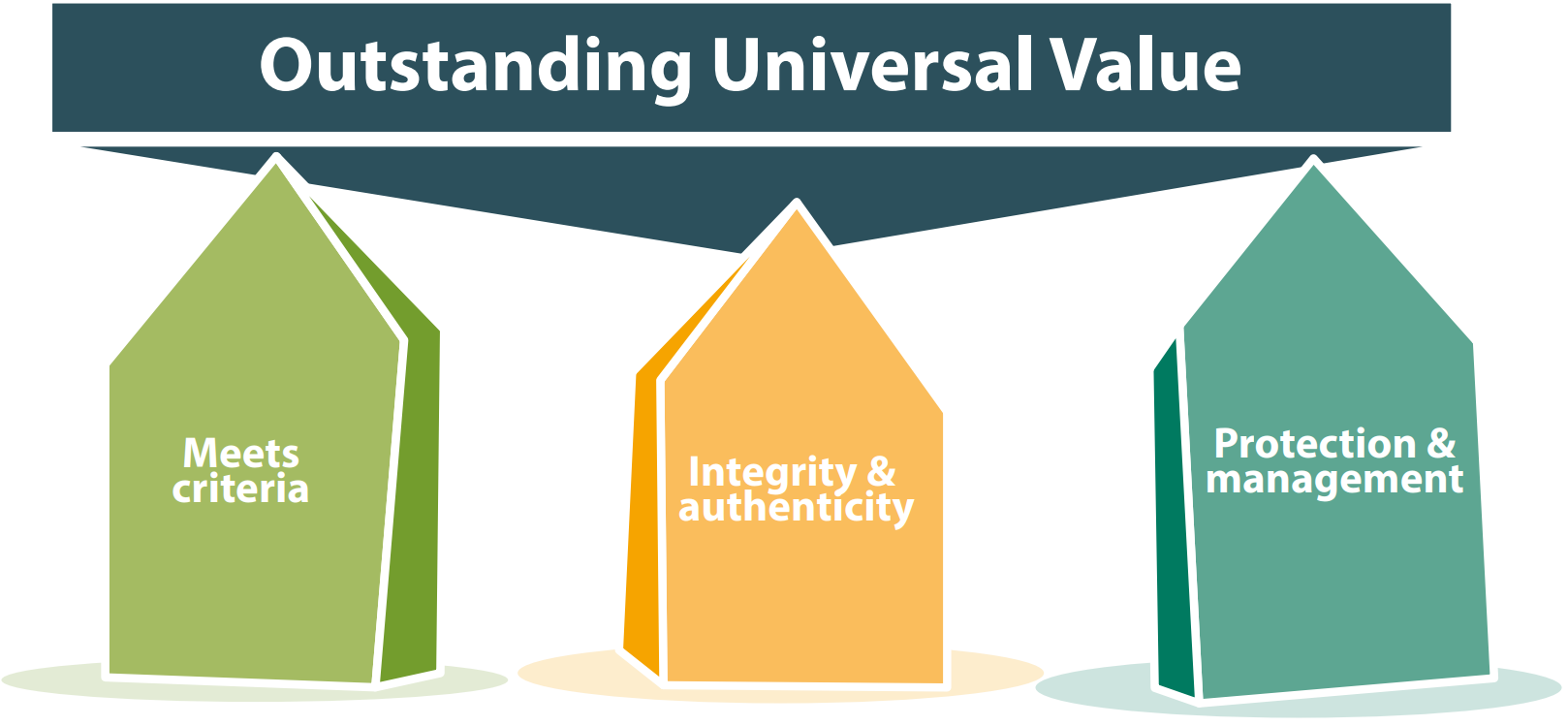
Figure 3.1. The ‘three pillars’ of Outstanding Universal Value.
The Statement of Outstanding Universal Value includes a description of the values and attributes of the for which it was inscribed on the World Heritage List. The OUV, including its authenticity and integrity, must continue to remain protected for any property on the World Heritage List. These concepts are important for carrying out impact assessment in a World Heritage context.
are what makes a heritage place special, and a particular combination of heritage/conservation values will explain why one specific place is of particular importance. In the case of a , the value that is considered to be ‘of importance for present and future generations of all humanity’ is its OUV (see Box 3.3 for an example). A may also have other heritage/conservation values that need to be considered in impact assessment, for instance, those that underpin national and local heritage designations, and/or the values held by of Indigenous peoples and associated communities. These may be formally designated or informally recognized.
are the elements of a heritage place that convey its values and makes them understandable. They can be physical qualities, relating to the material fabric and other tangible features, but can also be intangible aspects such as processes, social arrangements or cultural practices, as well as associations and relationships which are reflected in physical elements of the property.
For cultural heritage places, attributes can be buildings or other built structures and their forms, materials, design, uses and functions but also urban layouts, agricultural processes, religious ceremonies, building techniques, visual relationships and spiritual connections. For natural properties, attributes can be specific landscape features, areas of habitat, flagship species, aspects relating to environmental quality (such as intactness, high/pristine environmental quality), scale and naturalness of habitats, and size and viability of wildlife populations.
may extend over vast areas and may depend on processes occurring outside a
.
, and the interactions between them, should be the focus of protection, conservation and management actions. The term ‘attributes’ is particularly used for World Heritage properties to describe how Outstanding Universal Value is identified and conveyed, and a clear understanding of the attributes that convey a property’s Outstanding Universal Value is critical for their long-term protection. The spatial distribution of those attributes and their respective protection requirements should inform the boundary of the property, its buffer zone and other management actions.
The term ‘attribute’ is particularly used for World Heritage properties to describe how Outstanding Universal Value is identified and conveyed (see Box 3.3).
Box 3.3. Example of a Statement of Outstanding Universal Value (extract)
Blue Sea Marine Park and the Old Town of Heritopolis
The property is located in an ecologically and globally outstanding region, the Blue Sea. The property covers 400,000 ha with a buffer zone of 600,000 ha comprising both marine and terrestrial areas. It is part of a larger transition area between northern and southern biogeographic zones and its marine systems have developed unique and different ecosystems and species, including endangered ecological communities. The largely undisturbed habitats include rare examples of tropical coral reef systems and unique soft coral species. The property and its surrounding area also include seagrass beds and mangrove habitats. These habitats are home to populations of seabirds, marine mammals, fish, corals, sharks, manta rays and marine turtles, and the site provides important feeding grounds for the last remaining healthy population of endangered orange dugong. BSMP is an important larvae source area and hosts spawning sites for commercial fish species…
Located on the Blue Sea coast, the historic port town of Heritopolis has played a role throughout history as a place of interchange between historic cultures over time. While much of the architecture reflects the city’s golden age of wealth as a trading port in the 18th century, the buildings respect the much older urban layout that dates back to the 6th century. The 18th-century urban plan placed equal emphasis on the built fabric as on public green spaces within the city centre. In addition, within the urban fabric are a range of significant monuments from each stage of the city’s history: the Mausoleum of Eugenius, the Basilica of St Helena and the Great Mosque with its madrasa and baths, are all important architectural masterpieces of different periods. The eclectic mix of vernacular and monumental architecture reflects the diverse communities who have lived in the city for one and a half millennia and who continue to follow traditional practices today…
Source: World Leadership
Note: In this extract, the values have been underlined (values: why is this heritage place special?) and attributes are in italics (attributes: how can we see those values if we visit the place?)
A is defined by a boundary, and ideally all the attributes of OUV will be located within that boundary. In most cases, a should also be surrounded by a formally recognized World Heritage buffer zone(s) which supports the protection of the property’s OUV and attributes, e.g. by providing visual access to the sky behind a significant skyline, or by connecting components of a . Buffer zones have complementary legal restrictions placed on their use and development to provide an added layer of protection to the . Maps illustrating both boundaries and buffer zones can be found on the World Heritage website and they are a requirement for the successful submission of a nomination. Depending on the country, different legal, policy and management frameworks will apply to the property and buffer zone.
Every is surrounded by a wider setting, which is the immediate and extended environment that is part of, or contributes to, its significance and distinctive character. It may relate to the property’s topography, natural and built environment, and other elements such as infrastructure, land use patterns, spatial organization and visual relationships. It may include related ecological and hydrological connectivity, social and cultural practices, economic processes and other intangible dimensions of heritage such as perceptions and associations. The wider setting might also play an essential role in protecting the authenticity and integrity of the property, and its management is related to its role in supporting the Outstanding Universal Value.
While buffer zones typically cover the immediate area around the , the wider setting may be unprotected or protected by different legislation. This can lead to the risk that a proposed action is planned for the wider setting without considering the potential impacts on the . The wider setting of the property may be shown on a map, but in many cases will need to be identified as part of the impact assessment scoping process. The wider setting may be small or indeed limited to the buffer zone, for example where views are limited for a property whose OUV relates to its architecture; or large, for instance where extensive wildlife corridors are needed to provide a migration route for animals that contribute to the property’s OUV (see Figure 3.2). Due to the relationship between a and its wider setting, some proposed actions might have an impact on OUV. Hence, it is important that impact assessment looks at the wider setting of the .
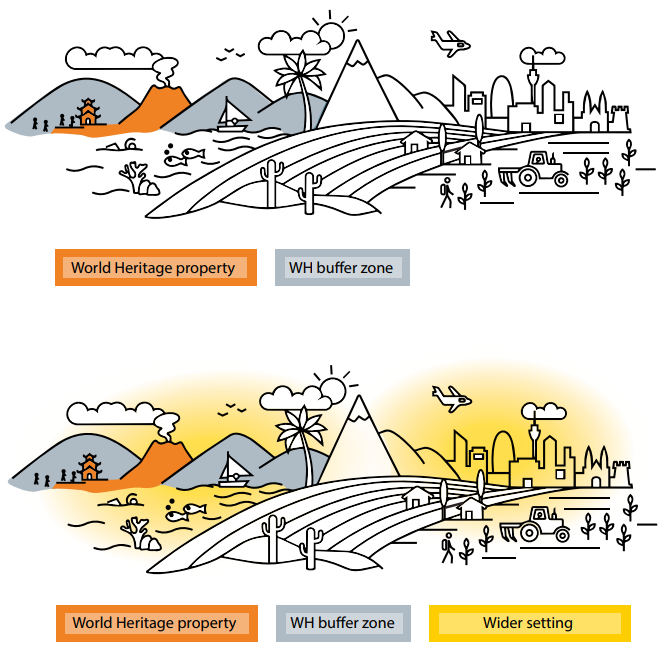
Figure 3.2. Example of
(orange), its buffer zone (grey) and interdependency on its wider setting (yellow)